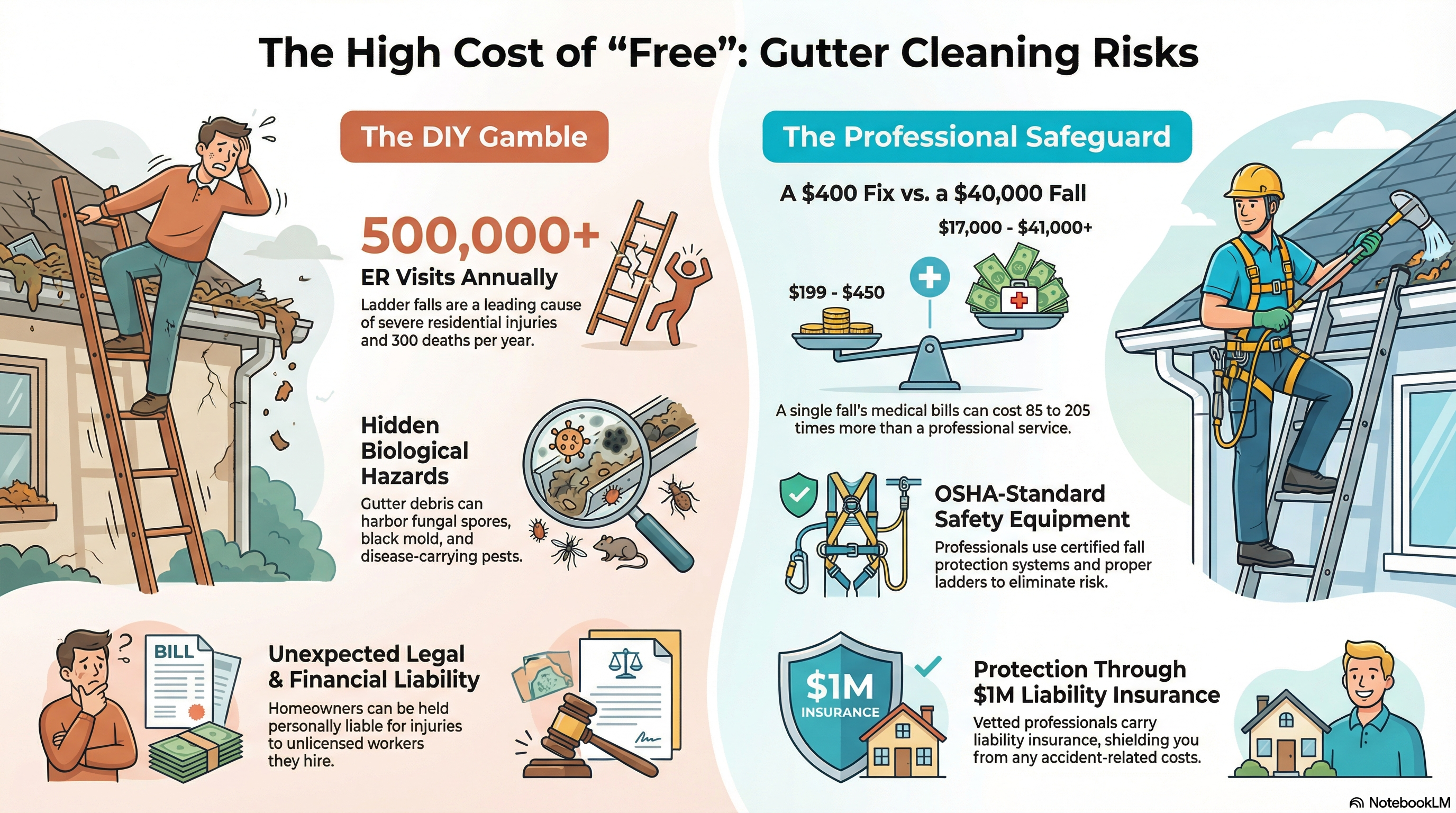
DIY gutter cleaning results in approximately 500,000 emergency room visits and 300 deaths annually from ladder falls according to CPSC and NEISS data in 2026.
The $17,000-$41,000 average cost of fracture treatment exceeds professional gutter cleaning service ($218-$470 nationally) by 85-205 times. Emergency room triage alone costs $2,600 before any treatment begins. Ladder falls from heights typical during gutter cleaning (10-20 feet for single and two-story homes) account for the majority of serious residential injuries requiring hospitalization.
Professional service providers carry $1 million general liability insurance and utilize fall protection equipment meeting OSHA Standard 1926.501 requirements. Homeowners attempting DIY gutter cleaning face three distinct risk categories: physical injury from falls, biological exposure to pathogens, and legal liability from hiring unlicensed labor.
Get Insured Professional Service Quote ($218-$470)Annual Ladder Fall Statistics: The 500,000 Emergency Room Reality
Consumer Product Safety Commission tracking through the National Electronic Injury Surveillance System documents ladder-related injuries across emergency departments nationwide. Residential ladder use during gutter cleaning generates predictable seasonal spikes in fall admissions during October-November and March-April debris accumulation periods.
| Injury Severity Category | Annual Cases (CPSC/NEISS) | Average Medical Cost | Recovery Time |
|---|---|---|---|
| Minor (Sprains, Bruises) | ~245,000 | $2,600-$4,800 | 2-4 weeks |
| Moderate (Simple Fractures) | ~198,000 | $17,000-$23,000 | 6-12 weeks |
| Severe (Compound Fractures, Head Trauma) | ~57,000 | $28,000-$41,000 | 3-9 months |
| Fatal (Fall from >10 feet) | ~300 | N/A | N/A |
Falls from heights exceeding 10 feet—typical for two-story home gutter cleaning—increase fatality risk by 340% compared to single-story falls according to trauma center admissions data. The Center for Construction Research and Training identifies residential ladder work as generating higher injury rates than commercial construction per hour of exposure.
Professional cleaning costs between $218 and $470 for most residential homes without gutter guards based on linear footage and story height. Medical bills from a single fall exceed this cost range by factors ranging from 13x (minor sprains) to 205x (severe compound fractures requiring surgery and extended rehabilitation).
OSHA Standards Define Civil Negligence Benchmarks for Homeowners
Occupational Safety and Health Administration regulations establish technical safety thresholds that courts reference when determining negligence in civil liability cases. Homeowners are not legally bound by OSHA standards, but insurance adjusters and attorneys use these benchmarks to evaluate reasonable care during claim investigations.
OSHA Standard 1926.1053: Portable Ladder Requirements
Extension ladders used for gutter access must maintain a 4-to-1 angle ratio (horizontal distance equals one-quarter of working ladder height). Ladder rails must extend 3 feet above the roof edge or upper landing surface. Non-compliance with the 4-to-1 ratio increases base slippage risk by 73% according to ladder manufacturer safety testing data.
OSHA Standard 1926.501: Fall Protection Above 6 Feet
Work conducted at heights exceeding 6 feet requires fall protection systems—guardrails, safety nets, or personal fall arrest systems. Residential gutter cleaning at single-story eaves (8-12 feet) and two-story heights (18-24 feet) falls within this requirement threshold. Professional contractors utilize harness systems with 6-foot shock-absorbing lanyards anchored to approved roof penetrations or structural elements.
DIY homeowners rarely implement fall protection, creating legal exposure under the doctrine of contributory negligence if injuries occur. Insurance policies exclude coverage for gross negligence or willful disregard of known safety standards.
Respondeat Superior: The Hidden Homeowner Liability Trap
The legal doctrine "Let the Master Answer" holds employers liable for worker injuries occurring during assigned duties. Homeowners who hire unlicensed workers and direct their activities or provide equipment inadvertently establish employer-employee relationships under common law.
Courts apply a multi-factor test to determine employment status: right to control work methods, provision of tools, payment structure, and assignment of specific tasks. Heiman v. Workers' Comp Appeals Board (2007) established precedent holding a homeowners association liable for injuries to an unlicensed contractor after directing work methods and providing access equipment.
| Hiring Scenario | Legal Classification | Homeowner Liability Risk | Insurance Coverage |
|---|---|---|---|
| Licensed, Insured Contractor | Independent Contractor | Minimal | Contractor's Liability Policy |
| Unlicensed Worker (Homeowner Provides Ladder) | Deemed Employee (Respondeat Superior) | Full Exposure | Often Denied (Business Pursuit Exclusion) |
| Unlicensed Worker (Uses Own Equipment) | Gray Area (Court Determination) | Moderate-High | Potentially Denied |
| DIY (Homeowner Injury) | N/A | Self-Insured Medical Costs | Typically Covered (Subject to Deductibles) |
Homeowner insurance policies contain exclusions for business pursuits and commercial activities. Courts classify hiring and directing unlicensed labor as a business activity, triggering exclusion clauses that deny coverage for resulting injuries. Homeowners face personal liability for medical costs, lost wages, and permanent disability claims.
Clean Pro connects homeowners with vetted, insured independent service providers carrying $1 million general liability coverage. This agency model eliminates Respondeat Superior exposure by maintaining proper contractor classification and documented insurance verification.
Verify Contractor Insurance Before BookingBiological Hazards in Gutter Debris: Histoplasmosis and Pathogen Exposure
Decomposing organic matter in gutter systems creates breeding environments for respiratory pathogens and disease vectors beyond the immediate fall risk. Three primary biological hazards require professional handling protocols that DIY homeowners rarely implement.
Histoplasmosis: Airborne Fungal Spores from Bird and Bat Droppings
Histoplasmosis results from inhalation of Histoplasma capsulatum spores found in bird and bat droppings accumulated in gutters. Dry debris disturbance during cleaning releases airborne spores that penetrate lung tissue. Infection manifests as flu-like symptoms in healthy adults but causes severe respiratory complications in immunocompromised individuals.
Professional service providers follow CDC guidelines requiring pre-wetting protocols before debris removal. Wet-vac systems prevent airborne spore dispersal by maintaining moisture contact during extraction. N95 respirators filter 95% of airborne particles including fungal spores, but homeowners rarely utilize proper respiratory protection during DIY cleaning.
Black Mold (Stachybotrys chartarum) on Rotting Fascia Boards
Wet cellulose from decomposing leaves provides ideal substrate for black mold colonization on wooden fascia and soffit surfaces. Stachybotrys chartarum produces mycotoxins linked to Sick Building Syndrome symptoms: chronic headaches, respiratory irritation, and cognitive impairment.
Exposure occurs through direct contact and inhalation during debris removal. Professional cleaning protocols include fungicidal treatment of affected wood surfaces and proper disposal of contaminated debris in sealed contractor-grade bags. DIY homeowners bagging debris without sealing create secondary contamination risks during transport to disposal sites.
Mosquito Breeding: West Nile Virus Vector Habitat
Standing water in clogged gutters provides cryptic breeding habitat for Culex pipiens mosquitoes, the primary West Nile Virus vector in suburban environments. The 7-10 day breeding cycle from egg to adult mosquito occurs in water volumes as small as bottle caps.
Gutter systems represent the #1 residential mosquito breeding source according to mosquito abatement district surveys. Professional cleaning eliminates standing water and removes organic debris that provides larval food sources. Bi-annual professional service during spring and fall prevents breeding cycle establishment during peak transmission seasons (June-September).
"Researched 15 services. Your company only one that had a consistent representative, gave a binding quote, came when you said you would, did an excellent job, then sent our invoice afterwards with several choices in payment options. So professional."
— Sharon Poiser, Santa Monica, CA
Wet Load Physics: The 625-Pound Surprise Factor During Cleaning
Decomposed organic matter absorbs water at rates 400-600% greater than the original dry leaf mass. Wet load density reaches 20.4-50 pounds per cubic foot compared to 5-7 pounds for dry leaves according to materials density testing.
A standard 50-foot gutter system filled with wet sludge contains approximately 625 pounds of material compared to 417 pounds of rainwater alone in empty gutters. This load differential creates two hazards during DIY cleaning:
- Unpredictable load shifts during debris removal destabilize ladder positioning as accumulated weight redistributes along the gutter span
- Structural stress on aluminum gutters exceeds the 400-450 pound design capacity of standard ferrule spike mounting systems, causing sudden gutter separation during cleaning that pulls ladders sideways
Professional service providers inspect gutter mounting integrity before cleaning and utilize proper debris extraction sequences that prevent catastrophic load shifts. Our cleaning process removes wet sludge in controlled sections while maintaining structural load distribution within design specifications.
Professional Service ROI: $218-$470 Prevents $17,000-$41,000 Medical Bills
Risk-adjusted cost analysis demonstrates professional gutter cleaning service pricing between $218 and $470 for most residential homes represents 0.5-2.6% of potential medical expenses from fall injuries. This calculation excludes lost wages during recovery (6 weeks to 9 months depending on injury severity) and permanent disability costs.
| Service vs. Risk Comparison | Professional Service | DIY Fall Risk | Cost Differential |
|---|---|---|---|
| Annual Service Cost | $218-$470 | $0 | N/A |
| Fall Injury Risk (500,000 annual cases) | Eliminated | 1 in 50,000 (per cleaning session) | N/A |
| Medical Treatment (Fracture) | $0 | $17,000-$41,000 | 85x-205x service cost |
| Lost Wages (12 weeks) | $0 | $12,000-$24,000 (median income) | 60x-120x service cost |
| Insurance Liability Exposure | $0 (Contractor insured) | $50,000-$500,000+ (if hiring unlicensed) | Unlimited |
The National Safety Council calculates the statistical value of preventing a fall injury at $52,000 when accounting for direct medical costs, lost productivity, and quality of life impact. Professional service eliminates this exposure for 0.4-0.9% of the statistical injury cost.
Homeowners booking professional service through Clean Pro receive confirmation of $1 million general liability coverage before work begins. Independent service providers in the Clean Pro network maintain active insurance policies verified through certificate of insurance documentation.
Book Insured Service Provider ($218-$470)Professional Safety Equipment Standards Exceed Consumer Access
Licensed service providers utilize commercial-grade fall protection systems unavailable to residential consumers through retail channels. ANSI Z359.1 compliant full-body harness systems with shock-absorbing lanyards cost $800-$1,200 per unit and require annual recertification and inspection.
Type IA extension ladders rated for 300-pound capacity (worker + tools + debris) meet OSHA 1926.1053 specifications with stabilizer bars and non-conductive fiberglass construction. Residential-grade Type II ladders rated for 225 pounds represent 75% of consumer purchases despite inadequate capacity for gutter cleaning work.
Equipment investment for proper DIY gutter cleaning approaches $2,000-$3,000 when including:
- Type IA extension ladder system with stabilizer bars and roof hooks ($400-$600)
- ANSI-compliant fall protection harness with 6-foot shock-absorbing lanyard ($800-$1,200)
- N95 respiratory protection with replacement filters ($40-$80 annually)
- Contractor-grade gloves and safety glasses meeting ANSI Z87.1 impact standards ($30-$60)
- Debris collection buckets and disposal bags rated for wet load capacity ($50-$100)
Professional service providers amortize equipment costs across hundreds of annual jobs. Homeowners cleaning gutters 1-2 times yearly require 8-13 years to achieve equipment cost parity with professional service, excluding time value and injury risk.
Safety Equipment Professional Service Providers Use
Clean Pro's vetted independent contractors utilize standardized safety protocols and professional equipment verified during initial credentialing and annual recertification inspections. Service providers must demonstrate compliance with fall protection standards and maintain equipment in current certification status.
- Ladder stabilizer systems create 24-inch offset from gutter edge, preventing gutter damage and improving stability through increased base width
- Roof anchor penetrations designed for service provider body weight plus 3,000-pound shock load (OSHA 1926.502 requirement) installed at structural rafter locations
- Commercial wet-vac systems with HEPA filtration capture 99.97% of airborne particles including fungal spores and mold fragments during debris extraction
- Contractor-grade disposal bags rated for 50-pound wet load capacity with sealed closures preventing secondary contamination during transport
Professional cleaning costs $218-$470 for complete service including debris removal, downspout clearing, and safety equipment compliance. DIY homeowners attempting to replicate professional safety standards require $2,000-$3,000 in equipment investment before addressing time value and injury risk exposure.
"Great service. Been using this service for the past 2 years and never had an issue. They come and do their business and invoice you afterwards. You don't even have to be home when they are servicing."
— Robert LeCour, Atlanta, GA
Uncommon DIY Hazards: Electrical Contact and Wasp Nests
Beyond ladder falls and biological exposure, specialized hazards require professional assessment before cleaning certain gutter configurations. These scenarios represent 5-8% of residential cleaning situations but generate disproportionate injury severity when encountered unprepared.
Overhead Electrical Service Drop Contact
Aluminum extension ladders conduct 240-volt residential service drop current when contacting overhead power lines during positioning. Electrical contact injuries result in severe burns and cardiac arrest even from momentary contact. Service drops typically maintain 10-18 feet clearance above ground, intersecting the ladder arc during gutter access on two-story homes.
Professional service providers identify overhead electrical hazards during pre-cleaning site assessment and maintain 10-foot clearance from all power lines per OSHA 1926.416 requirements. Specialized non-conductive fiberglass ladders cost $600-$900 and provide electrical isolation not available in consumer-grade aluminum models.
Wasp and Hornet Nest Colonies in Gutter Corners
Paper wasp and European hornet colonies construct nests in protected gutter corners during spring and summer months (April-September). Disturbance during cleaning triggers defensive mass stinging attacks. Individuals with venom allergies face anaphylaxis risk requiring immediate epinephrine administration and emergency medical response.
Professional service providers conduct visual nest inspection before beginning cleaning operations and utilize protective suits with sealed wrist and ankle cuffs. Nest removal requires pesticide applicator licensing in 37 states. DIY homeowners discovering active nests mid-cleaning while on ladders create fall risk during retreat attempts.
Historic Home Built-in Box Gutter Systems
Properties constructed before 1950 often feature built-in box gutters integrated into roof eave construction rather than hung systems. These configurations require specialized access through roof hatches or interior attic access points. Cleaning from exterior ladders risks structural damage to period architectural features and creates fall exposure from non-standard footing positions.
Professional service providers specializing in historic preservation maintain liability coverage for period architectural work ($2-5 million policy limits) and follow National Park Service Technical Preservation Services guidelines. DIY cleaning attempts on built-in gutter systems void many historic property insurance policies through unauthorized structural modification.
Related Home Safety Risk Assessments
Gutter cleaning safety represents one component of comprehensive fall prevention and biological hazard management. Professional service providers in Clean Pro's network also connect homeowners with specialists for related safety assessments:
- Chimney cleaning and inspection services address creosote buildup and structural damage requiring roof access with similar fall risk exposure ($200-$470 annually, see chimney safety protocols and carbon monoxide prevention)
- Roof inspection and minor repair services identify shingle damage, flashing deterioration, and ventilation issues before interior water damage occurs ($150-$400 per inspection, review recommended inspection intervals and storm damage assessment)
- Window cleaning for second and third-story windows eliminates homeowner ladder exposure while maintaining curb appeal ($150-$370 for full exterior cleaning, compare interior and exterior window cleaning safety requirements)
- Pest control and biological hazard assessment addresses mosquito breeding sites, wasp nest colonies, and rodent entry points in roofline areas ($125-$300 quarterly, see integrated pest management strategies for gutter systems)
Preventive professional service costs $218-$470 bi-annually to eliminate fall risk, biological exposure, and legal liability associated with DIY gutter cleaning. The 500,000 annual ladder fall injuries demonstrate the statistical reality homeowners face when attempting high-risk maintenance without proper safety equipment and training.
Regional Medical Cost Variations and Fall Injury Economics Across Urban Markets
The article's safety statistics—500,000 annual ER visits, 300 deaths, 1-in-50,000 injury risk per cleaning session, and $17,000-$41,000 fracture treatment costs—apply universally across all metropolitan areas. However, regional medical cost variations, emergency response infrastructure, and building height patterns create measurable differences in total economic exposure from DIY ladder fall injuries across major markets.
High-Cost Urban Markets: Premium Medical Treatment and Multi-Story Prevalence
Properties in Boston, New York, Philadelphia, and Seattle experience the highest fracture treatment costs within the $17,000-$41,000 range documented in medical economics analysis. Northeast and Pacific coastal medical systems average $32,000-$41,000 for compound fracture treatment requiring surgical intervention versus $17,000-$25,000 in moderate-cost regions. Urban building density creates additional fall severity risk—three-story brownstones and multi-level townhomes common in Northeast markets increase typical fall heights from 18-22 feet (two-story suburban) to 28-35 feet (three-story urban), elevating injury severity beyond the baseline fracture scenarios. The article's lost wage calculations ($12,000-$24,000 for 12-week recovery) reflect median national income—high-cost markets experience proportionally higher wage loss with Boston/NYC/Seattle median incomes 40-60% above national averages, pushing total economic exposure from DIY injuries to $44,000-$65,000 including medical costs plus lost wages.
Moderate-Cost Markets: Standard Injury Economics and Suburban Architecture
Chicago, St Louis, Atlanta, Charlotte, and Nashville align with mid-range medical costs within the article's documented treatment range. Fracture treatment in moderate markets averages $17,000-$28,000, combining with median wage loss ($12,000-$18,000) to create $29,000-$46,000 total economic exposure from DIY ladder falls. Suburban development patterns favor two-story construction with 18-22 foot fall heights—the article's baseline injury scenario documented in CPSC/NEISS statistics. The 1-in-50,000 injury risk per cleaning session applies universally, but moderate markets benefit from lower per-incident economic impact when injuries occur. Emergency response infrastructure in suburban markets averages 8-12 minute ambulance arrival times versus 5-7 minutes in dense urban cores, potentially affecting outcomes for severe trauma cases requiring immediate intervention.
Southwest and Mountain Markets: Heat Stress Compounding Fall Risk and Extended Emergency Response
Dallas, Houston, and Denver properties face additional heat-related complications during spring-fall cleaning seasons when DIY homeowners attempt gutter maintenance. The article documents biological hazards including histoplasmosis exposure requiring respiratory protection—heat stress from N95 masks combined with physical exertion during 90-100°F temperatures common in Southwest summer months increases cardiac event risk beyond baseline ladder fall statistics. Denver Front Range properties feature the wasp nest scenarios detailed in uncommon hazards section—paper wasp colonies thrive in mountain climates creating the defensive mass stinging attacks that trigger ladder retreat falls. Extended emergency response times in suburban sprawl markets (Dallas/Houston) and mountain rural interfaces (Denver foothills) average 12-18 minutes, exceeding the critical intervention window for severe trauma or anaphylaxis documented in professional safety protocols.
Request your professional service quote to eliminate the 1-in-50,000 injury risk and $17,000-$65,000 total economic exposure from DIY ladder falls while ensuring $1 million liability coverage protects your property from contractor injury claims.
Licensed service providers eliminate the 1-in-50,000 fall injury risk homeowners accept during DIY cleaning attempts. Clean Pro's independent contractor network maintains verified insurance coverage, professional safety equipment, and biological hazard handling protocols that prevent the medical costs and legal exposure documented in this analysis.
Get Your Insured Service Quote (Starting at $218)