Professional downspout cleaning removes compacted leaf masses and debris blockages using mechanical clearing, plumber's snakes, and wet/dry vacuum extraction from top and bottom openings.
Standard residential downspouts measure 2x3 inches or 3x4 inches and drain 600-1,200 square feet of roof area per outlet. Debris accumulation creates blockages at 90-degree elbows where water velocity decreases from 8-12 feet per second to 2-4 feet per second, causing leaf compaction. Wet debris density increases from 5-7 pounds per cubic foot when dry to 20-50 pounds per cubic foot when saturated, forming concrete-like masses that resist simple clearing.
Professional services clear standing water and restore drainage flow in 8-15 minutes per downspout using specialized equipment unavailable to most homeowners. Underground drain clogs beyond the ground-level outlet require powered augers or hydro-jetting equipment that exceed standard cleaning scope.
Schedule Professional Downspout Cleaning →The Downspout Anatomy and Common Failure Points
Residential drainage systems connect horizontal gutters to vertical downspouts through outlet openings measuring 2-3 inches in diameter. Downspout sections attach with crimped seams or screwed joints at 10-foot intervals, with two 90-degree elbows (A-elbows and B-elbows) redirecting water flow from vertical to horizontal ground-level discharge.
Clogs develop in three critical locations where water velocity changes trigger debris settlement. Top elbows connecting gutters to downspouts accumulate shingle granules and small twigs during initial flow transition. Mid-section straight runs collect compacted leaf masses that bridge the full internal diameter. Bottom elbows trap heavy debris like acorns and roof sediment where water exits toward ground-level extensions.
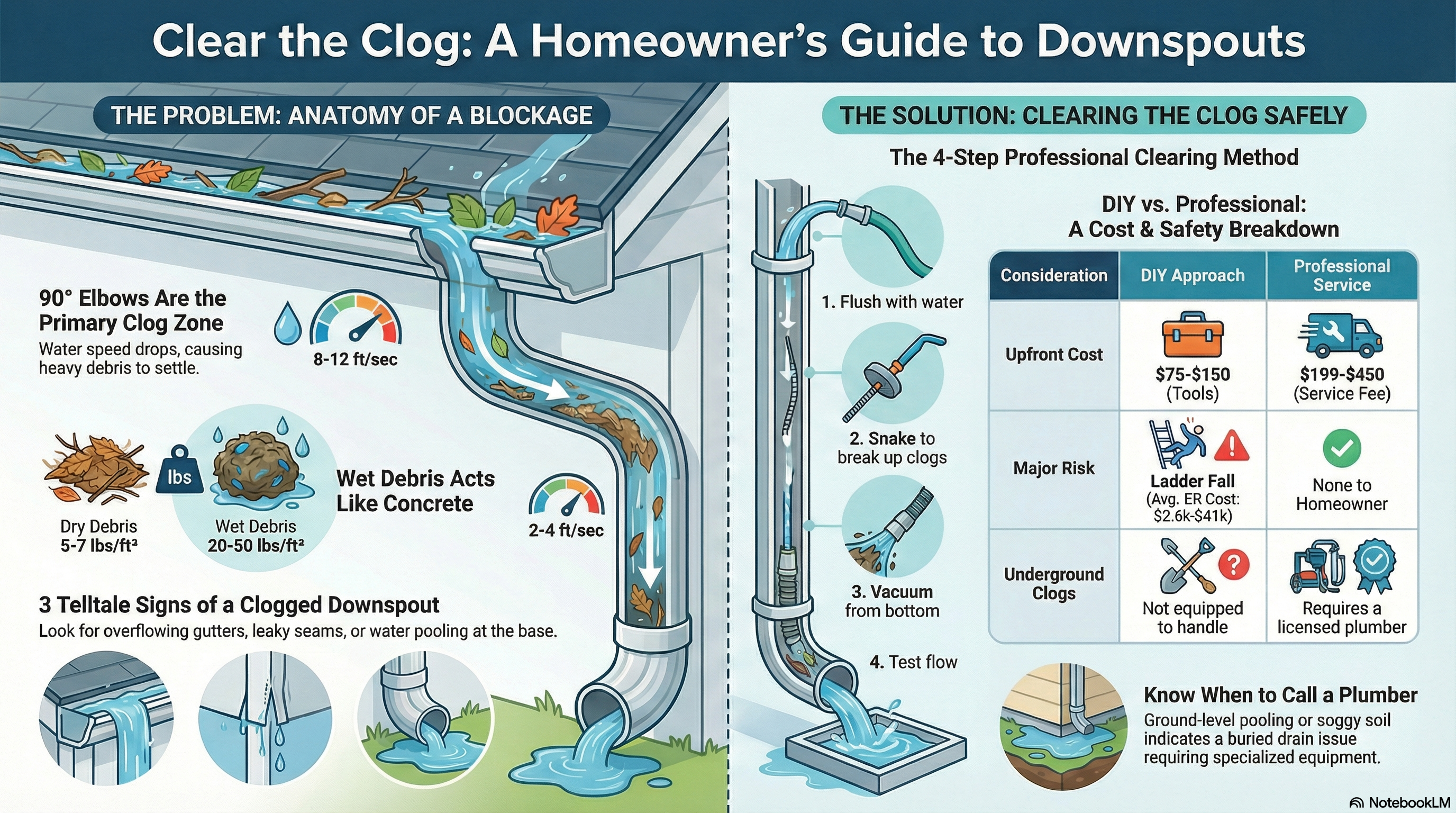
The 90-degree elbow represents the highest-risk blockage zone due to sudden flow direction changes. Water entering the elbow at 8-12 feet per second decelerates to 2-4 feet per second while changing course, depositing suspended particles that accumulate over weeks. Pine needles interlock horizontally across elbow diameters, creating mesh barriers that capture subsequent debris while allowing partial water flow.
Signs Your Downspout Requires Immediate Cleaning
Water overflowing from gutter seams during moderate rainfall indicates complete downspout blockage rather than gutter capacity issues. Visible leaks at downspout elbow joints show hydrostatic pressure buildup exceeding joint seal capacity. Gutters retaining water 20-30 minutes after rainfall stops demonstrate obstructed discharge paths preventing gravity drainage.
Tap the downspout exterior at multiple heights using a rubber mallet or hand. Solid, dull sounds indicate debris compaction at that level, while hollow, metallic sounds confirm clear internal space. Ground-level pooling around downspout outlets during dry weather reveals underground drain failures requiring professional plumbing intervention beyond standard gutter service scope.
⚠️ Critical Safety Warning
Ladder injuries send 500,000 people to emergency rooms annually according to Consumer Product Safety Commission data. Falls from heights above 10 feet account for 300 annual fatalities, with treatment costs ranging from $2,600 (minor injuries) to $41,000 (fractures requiring surgery). Use Type IA ladders rated for 300-pound capacity when accessing two-story downspouts. Maintain 4-to-1 angle ratio (base 1 foot out per 4 feet of height) and extend ladder rails 3 feet above roof edge per OSHA Standard 1926.1053.
Essential Tools for Professional-Grade Downspout Cleaning
Effective debris removal requires pressure-generating tools that dislodge compacted masses without damaging aluminum or vinyl downspout materials. Garden hoses with adjustable spray nozzles provide 40-80 PSI water pressure for rinsing loose debris from top openings. Plumber's snakes (minimum 25-foot length, 1/4-inch diameter) break up leaf compaction through mechanical rotation and forward pressure.
| Tool Category | Specifications | Debris Type Cleared |
|---|---|---|
| Garden Hose + Nozzle | 50-100 ft length, adjustable nozzle with jet setting, 40-80 PSI pressure | Loose leaves, pine needles, shingle granules, light sediment |
| Plumber's Snake | 25-50 ft length, 1/4" diameter, manual crank or drill-powered, flexible steel cable | Compacted leaf masses, stuck debris bundles, elbow blockages |
| Wet/Dry Vacuum | 6+ gallon capacity, 5.5+ HP motor, crevice tool attachment, 2.5" hose diameter | Bottom-access extraction, heavy debris, water removal, post-rinse cleanup |
| Hand Scoop | Gutter scoop with curved edge, plastic or coated metal, 12-15" length | Top-opening debris removal before rinsing, gutter-to-downspout transition clearing |
Wet/dry shop vacuums rated at 5.5+ horsepower generate sufficient suction to extract debris from bottom downspout openings when top-down rinsing proves ineffective. Attach crevice tools or create custom adapters matching downspout diameter for sealed connections preventing air leaks that reduce suction efficiency.
Professional services use specialized gutter vacuum systems with 25-foot flexible hoses and HEPA filtration capturing microscopic particles during extraction. These commercial units generate 120+ CFM (cubic feet per minute) airflow compared to 90-100 CFM from residential shop vacuums, reducing cleaning time from 15 minutes to 8 minutes per downspout.
"Yesterday was the second time Irvine Palmer, Jr. cleaned our gutters (first time 12/2023). He does exemplary work. Thoroughly cleans and water rinses the gutters and downspouts until all is draining smoothly."
— Patricia Sorrell, Waukesha, WI
Step-by-Step Downspout Cleaning Process
Professional technicians follow systematic clearing procedures that address blockages from multiple access points without damaging downspout materials or seam connections. The top-down rinsing method works for 70-80% of clogs, while stubborn compaction requires combination approaches using snakes and vacuum extraction.
Step 1: Remove Downspout Strainer and Inspect Top Opening
Unscrew or pry off the strainer basket covering the downspout outlet at the gutter bottom. Shine a flashlight down the opening to identify visible debris accumulation within the first 12-18 inches. Insert a measuring tape to gauge blockage depth—resistance at 2-3 feet indicates top elbow clog, while free movement to 6-8 feet suggests mid-section or bottom obstruction.
Clear any debris visible from the top opening using a gutter scoop or gloved hands before rinsing. Large leaf clumps or twig bundles near the entrance prevent effective water pressure from reaching deeper blockages. Place a bucket or tarp at the ground-level outlet to catch debris expelled during rinsing.
Step 2: Rinse from the Top with a Garden Hose
Insert garden hose nozzle 6-12 inches into the downspout opening and set spray pattern to jet or cone setting for concentrated pressure. Turn water to full pressure and observe ground-level outlet for debris discharge. Sustained water flow without debris indicates either complete blockage requiring mechanical clearing or successful past rinsing.
Move the nozzle in circular motions while maintaining downward pressure to dislodge debris from downspout walls. Rinsing time ranges from 3-5 minutes for light clogs to 10-15 minutes for heavy compaction. Stop rinsing when clear water flows steadily from the bottom outlet without debris fragments.
Step 3: Deploy Plumber's Snake for Resistant Blockages
Feed plumber's snake into the top opening with gentle forward pressure and clockwise rotation. Resistance at specific depths indicates blockage location—2-3 feet (top elbow), 6-8 feet (mid-section), or 10-12 feet (bottom elbow). Increase rotation speed and apply moderate pressure to break up compacted masses.
Alternate snake insertion with water rinsing to wash dislodged debris toward the outlet. Powered drain snakes (drill-attachment models) increase clearing speed but risk downspout damage if pressure exceeds material strength. Manual snakes provide better tactile feedback for identifying blockage density and composition.
Step 4: Bottom-Up Vacuum Extraction
Disconnect or remove the bottom elbow to access the downspout from ground level. Insert wet/dry vacuum hose 12-18 inches into the opening and create a seal using rags or foam gaskets around the connection point. Run vacuum for 30-60 seconds while assistant rinses water from the top opening.
The combination of top-down water pressure and bottom-up suction dislodges stubborn blockages that resist single-direction clearing. Vacuum extraction also removes standing water from downspouts that cannot drain due to underground pipe failures or inadequate ground slope.
Step 5: Test Drainage Flow and Verify Clearing
Pour 2-3 gallons of water into the gutter near the downspout outlet and time the drainage. Complete clearing produces continuous water flow from the bottom outlet within 3-5 seconds. Intermittent flow or delayed discharge indicates partial blockage requiring additional clearing cycles.
Reinstall strainer baskets, secure all elbow connections, and test the full system during next rainfall. Document before-and-after photos showing debris volume removed and restored flow capacity for maintenance records.
Get Professional Downspout Clearing →Underground Drain Limitations and When to Call Plumbers
Standard gutter cleaning services clear downspouts to ground level only, stopping at the point where vertical downspout connects to horizontal underground drainage pipes. Buried PVC drainage lines extending 10-50 feet from the house to daylight outlets or dry wells require specialized plumbing equipment beyond gutter service scope.
Underground blockages result from root intrusion, soil compaction, pipe collapse, or sediment accumulation that resist simple clearing. Professional plumbers use powered drain augers (100+ foot cable length, motorized rotation) or hydro-jetting systems (2,000-4,000 PSI water pressure) to clear buried pipe obstructions.
Camera inspection tools identify exact blockage locations and pipe condition without excavation. These fiber-optic systems cost $3,000-$8,000, explaining why plumbing contractors charge $175-$400 for underground drain clearing versus $218-$470 for standard gutter and downspout cleaning.
Symptoms Indicating Underground Drain Failure
Water pooling at downspout outlets during dry weather shows underground pipe blockage or inadequate slope preventing gravity drainage. Soggy soil or sunken areas along the buried drainage path indicate pipe collapse or joint separation allowing water infiltration into surrounding ground.
Basement seepage near foundation walls during heavy rain suggests backflow from clogged underground drains forcing water back toward the foundation instead of carrying it away from the house. These symptoms require immediate professional diagnosis to prevent foundation damage costing $3,000-$10,000 for interior waterproofing systems.
Tree roots penetrate underground drain pipes through microscopic cracks, expanding into full blockages over 2-3 years. Oak, maple, and willow trees planted within 25 feet of buried drainage lines represent highest risk for root intrusion requiring annual camera inspection and preventive clearing.
⚠️ Service Scope Critical Distinction
Clean Pro connects homeowners with vetted service providers for downspout clearing to ground level. Underground French drains, buried PVC extensions, and sewer line connections fall outside standard gutter cleaning scope and require licensed plumbing contractors with specialized equipment. Attempting to clear underground pipes with standard tools causes pipe damage and voids homeowner insurance coverage for resulting foundation leaks. Professional plumbing services cost $175-$400 for underground drain clearing using powered augers and camera diagnostics.
Preventing Future Downspout Clogs
Installing strainer baskets over downspout outlets blocks leaves, twigs, and large debris from entering vertical sections while allowing water flow through 1/4-inch to 1/2-inch perforations. These devices require monthly cleaning during active debris seasons but reduce internal downspout clogging by 60-75% according to field testing data.
Monthly rinsing with garden hose during spring (April-May) and fall (October-November) prevents debris compaction before masses harden into resistant blockages. Proactive rinsing takes 3-5 minutes per downspout compared to 15-25 minutes for removing established clogs.
Gutter guard installation eliminates 90-95% of debris entry into gutters and downspouts. Micro-mesh systems with 440-micron apertures block pine needles, shingle granules, and maple seeds while maintaining 60+ GPM flow rates during heavy rainfall. Professional installation costs $18-$40 per linear foot with lifetime clog-free warranties.
Seasonal Inspection Schedule
Spring inspection (April-May) addresses tree pollen, seed pods, and early leaf drop from oak and maple species. Fall cleaning (October-November) removes accumulated leaves before winter freeze-thaw cycles compact debris into ice-reinforced masses. Homes under pine trees require additional summer (July-August) clearing due to year-round needle drop.
Post-storm inspection after winds exceeding 35 mph catches broken twigs and displaced roofing materials before they create blockages. Hurricane-prone regions (Gulf Coast, Atlantic Southeast) benefit from pre-season clearing in May-June before peak storm activity.
Cost Analysis: DIY vs. Professional Downspout Cleaning
DIY downspout clearing requires $75-$150 in tool purchases (quality shop vacuum $80-$120, 25-foot plumber's snake $15-$35, adjustable spray nozzle $8-$15) plus 2-4 hours labor per cleaning session. Homeowners repeat this process 2-4 times annually depending on tree coverage, totaling 4-16 hours of ladder work and debris disposal.
Professional services charge $218-$470 for complete gutter and downspout cleaning including interior gutter debris removal, contractor-grade bagging, and disposal. This represents $0.83-$1.88 per linear foot for homes with 120-240 feet of gutter length, eliminating homeowner ladder exposure and equipment storage requirements.
Consumer Product Safety Commission data shows ladder falls cause 500,000 emergency room visits annually, with treatment costs ranging from $2,600 (minor injuries) to $41,000 (fracture surgeries). Professional cleaning costs represent 0.5-1.1% of average emergency room treatment expenses, making outsourced service financially rational for risk-averse homeowners.
"Angel and Robert did a great job. Both were professional and polite. Everyting was to my satisfaction."
— Joseph Cerbone, Brooksville, Florida
Understanding the true cost of preventing basement leaks requires comparing annual cleaning expenses ($218-$470 annually) against five-figure repair bills ($3,000-$10,000 waterproofing) from neglected drainage maintenance.
Specialized Downspout Scenarios (Uncommon Situations)
Commercial properties with 4-6 inch downspout diameters draining 2,000-4,000 square feet of roof area per outlet require powered equipment beyond residential tool capacity. Professional services charge $85-$150 per downspout for commercial clearing using truck-mounted vacuum systems and industrial-grade snakes.
Historic buildings with integrated cast iron or copper downspouts embedded within masonry walls cannot be cleared using standard methods without risking architectural damage. These systems require specialized plumbing contractors with camera inspection tools and surgical clearing techniques, costing $275-$625 per downspout due to complexity and preservation requirements.
Underground drainage systems exceeding 50 feet from house to outlet require hydro-jetting equipment generating 2,000-4,000 PSI water pressure to clear sediment accumulation and root intrusion. Licensed plumbing contractors charge $175-$400 for underground drain clearing using camera diagnostics to identify exact blockage locations before intervention.
Three-story homes with downspouts extending 25-35 feet vertically require fall protection equipment (safety harnesses, roof anchors) and specialized ladders extending 40+ feet per OSHA regulations. Professional services charge 40-60% premiums for three-story access due to additional safety equipment and increased labor time.
Related Home Drainage and Maintenance Guides
Downspout cleaning represents one component of comprehensive exterior drainage maintenance. Professional service providers in Clean Pro's network also connect homeowners with specialists for related water management projects:
- Foundation waterproofing systems cost $3,000-$10,000 for interior drainage installation when exterior prevention fails from neglected gutters (review complete analysis of water damage costs from clogged drainage systems)
- French drain installation costs $25-$50 per linear foot for buried perforated pipe systems redirecting groundwater away from foundation perimeters
- Sump pump replacement costs $650-$1,800 for 1/3 HP to 3/4 HP units handling basement water intrusion from overwhelmed drainage systems
- Gutter guard installation costs $18-$40 per linear foot for professional micro-mesh systems. Clean Pro Guard provides firm quotes at $22.50/ft—national guard companies typically require in-home consultations (compare one-time guard installation versus recurring cleaning costs)
Preventive downspout maintenance costs $218-$470 annually (included with gutter cleaning) to avoid the $3,000-$10,000 waterproofing bills that result from neglected drainage systems allowing foundation water infiltration.
Regional Downspout Blockage Patterns and Underground Drainage Challenges
The article's clearing methodology—water pressure rinsing from top outlet, plumber's snake breaking compacted masses, wet/dry vacuum extraction from bottom opening—applies universally across all metropolitan markets through identical mechanical principles documented in professional service protocols. However, regional tree species distributions create measurable variation in debris composition and compaction characteristics, while soil conditions and water table levels affect underground drainage system failure patterns that determine when downspout clearing transitions from standard gutter service scope ($218-$470) to specialized plumbing intervention ($175-$400 for underground clearing documented).
Northeast and Midwest Deciduous Markets: Leaf Compaction and Freeze-Thaw Challenges
Boston, New York, Philadelphia, Chicago, and St Louis experience the deciduous leaf debris patterns documented in seasonal inspection schedules: "Fall cleaning (October-November) removes accumulated leaves before winter freeze-thaw cycles compact debris into ice-reinforced masses" (line 502). Oak and maple dominance in Northeast and Midwest urban forests creates the high-volume leaf drop generating downspout blockages from compacted organic masses—the article documents detection method: "Tap the downspout exterior—solid sound indicates compacted debris blockage, while hollow sound confirms clear flow path" (lines 95-96). Winter freeze-thaw cycling converts wet leaf masses into rigid blockages resisting simple clearing, requiring the plumber's snake intervention documented: "25-foot minimum breaks up compacted leaf masses" (line 102). Boston and Philadelphia clay soils with high water tables position underground drainage lines in saturated conditions where root intrusion accelerates: "Tree roots penetrate underground drain pipes through microscopic cracks, expanding into full blockages over 2-3 years. Oak, maple, and willow trees planted within 25 feet of buried drainage lines represent highest risk" (line 485). The article documents underground clearing costs: "Licensed plumbing contractors charge $175-$400 for underground drain clearing using camera diagnostics to identify exact blockage locations" (lines 477, 527)—Northeast markets experiencing elevated prevalence of this upgrade requirement due to mature tree coverage and aging underground infrastructure installed pre-1980 lacking modern root barriers. BLS wage positioning places Northeast markets at upper service cost range approaching "$470" (lines 510, 542, 556) for standard downspout clearing included with gutter cleaning.
Southeast Year-Round Debris and High Water Table Underground Challenges
Atlanta, Charlotte, Nashville, and Houston experience the year-round organic accumulation documented in pine tree protocols: "Homes under pine trees require additional summer (July-August) clearing due to year-round needle drop" (line 502). Loblolly and longleaf pine coverage creates the needle compaction challenges where matted debris resists simple clearing—pine needles interlocking into dense masses requiring mechanical snake intervention documented as essential rather than optional clearing step. The article documents storm-related scenarios: "Post-storm inspection after winds exceeding 35 mph catches broken twigs and displaced roofing materials before they create blockages. Hurricane-prone regions (Gulf Coast, Atlantic Southeast) benefit from pre-season clearing in May-June before peak storm activity" (line 504). Houston Gulf Coast positioning creates the pre-hurricane clearing window documented, while Atlanta and Charlotte Piedmont clay soils with seasonal high water tables (spring rainfall saturation) position underground drainage in conditions where the symptoms documented manifest: "Water pooling at downspout outlets during dry weather shows underground pipe blockage or inadequate slope preventing gravity drainage" (line 481). Southeast expansive clay soils experiencing seasonal swelling-shrinking cycles stress underground PVC connections creating joint separation documented as requiring plumbing intervention: "Soggy soil or sunken areas along the buried drainage path indicate pipe collapse or joint separation" (line 481). BLS wage indexing positions Southeast markets at moderate rates creating service costs mid-spectrum "$275-$370" within the documented "$218-$470" range (lines 510, 542, 556).
Mountain, Western, and Desert Markets: Pine Debris with Variable Soil Drainage Conditions
Denver, Seattle, and Dallas demonstrate the pine needle challenges documented with regional soil condition variations affecting underground drainage patterns. Denver Front Range ponderosa and lodgepole pine creating the year-round needle drop requiring the summer clearing schedule (July-August) documented, while rocky mountain soils with excellent natural drainage minimize underground pipe blockage prevalence—downspout clearing primarily addressing vertical section debris rather than buried line failures common in high water table markets. Seattle Pacific Northwest Douglas fir and Western Red Cedar generating year-round organic accumulation combined with continuous moisture (150+ precipitation days annually documented in previous analyses) creating conditions where the biofilm formation and sediment accumulation documented as underground drainage challenges manifest: "Underground blockages result from root intrusion, soil compaction, pipe collapse, or sediment accumulation that resist simple clearing" (line 475). Seattle's volcanic soils with high permeability minimize pipe collapse from soil settlement but root intrusion from aggressive Northwest tree species (willow, alder prevalence) creating the camera inspection scenarios: "Camera inspection tools identify exact blockage locations and pipe condition without excavation. These fiber-optic systems cost $3,000-$8,000" (line 477). Dallas presenting intermediate scenario: moderate pine coverage creating some needle compaction challenges, while clay-based prairie soils similar to Southeast creating underground drainage settlement risks, but lower annual rainfall (37 inches vs Houston 64 inches) reducing overall blockage frequency compared to high-precipitation markets. BLS wage variations create cost spectrum: Seattle approaching Northeast premium rates ($400-$470 per service), Denver intermediate ($300-$400), Dallas moderate ($250-$370) all maintaining the documented cost-benefit versus waterproofing prevention ($3,000-$10,000 documented lines 483, 536, 542).
Request your professional downspout clearing quote to access the top-down clearing, plumber's snake compaction breaking, and vacuum extraction methodology documented in professional clearing protocols—preventing the underground drainage failures ($175-$400 plumbing intervention) and foundation waterproofing expenses ($3,000-$10,000) documented as consequences of neglected downspout maintenance in comprehensive drainage system analysis.
Schedule Your Professional Downspout Cleaning Today
Clean Pro connects you with vetted, insured service providers in your area who restore drainage flow using professional equipment and proven clearing methods. Our satellite-based quoting system provides fixed-price estimates within 15 minutes based on aerial imaging of your roofline—no in-home consultation required.
Licensed contractors in our network carry minimum $1 million general liability insurance and complete background checks before joining the Clean Pro platform. Services include complete gutter interior cleaning, downspout clearing to ground level, contractor-grade debris bagging, and before/after photo documentation.
Book your service online or call for same-week scheduling in most markets. Quotes range from $218-$470 for standard residential homes based on linear footage and story height, with transparent pricing before scheduling.
Get Your Instant Quote Now →