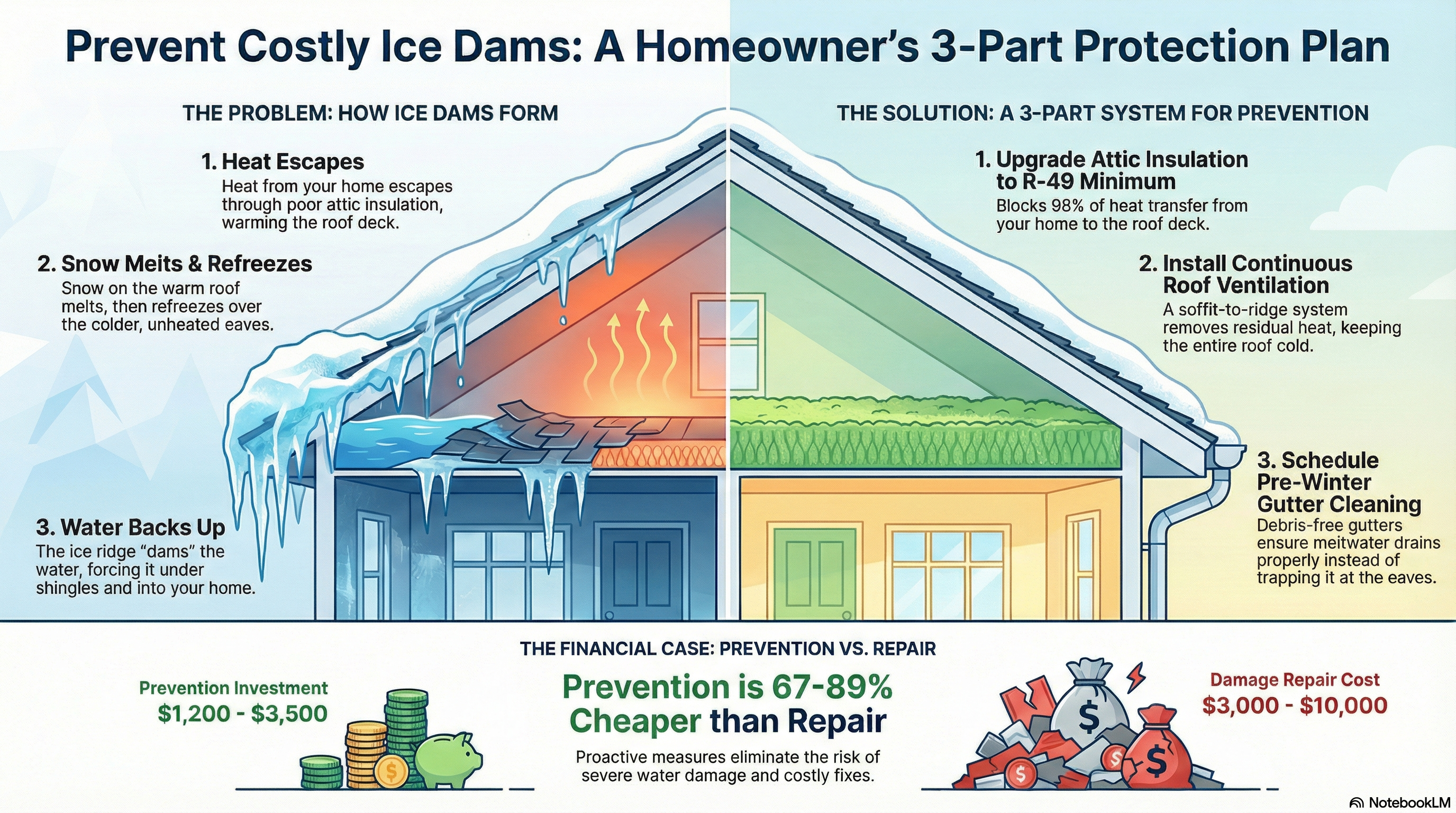
Homeowners prevent ice dams by upgrading attic insulation to R-49 minimum, installing roof ventilation systems with 1:300 net free area ratios, and scheduling pre-winter gutter cleaning to eliminate debris blockages that trap melting snow at eaves.
These three prevention methods work in combination rather than isolation. Attic insulation blocks heat transfer from living spaces to roof decks, ventilation removes residual heat accumulation, and clean gutters ensure unobstructed meltwater drainage during freeze-thaw cycles. Homes lacking any single component remain vulnerable to ice dam formation regardless of the other measures implemented.
Ice dam water damage repairs average $3,000-$10,000 per incident based on Insurance Services Office claim data, while prevention through insulation upgrades and gutter maintenance costs $1,200-$3,500. The cost differential makes prevention 67-89% less expensive than reactive repairs.
Schedule Pre-Winter Gutter Cleaning →The Physics of Ice Dam Formation (Why Heat Loss Triggers Water Backup)
Ice dams form through a three-stage thermal process initiated by inadequate attic insulation. Heat escaping from living spaces rises through ceiling penetrations and insufficient insulation barriers, warming the roof deck to temperatures exceeding 32°F. Snow accumulation on the warmed upper roof sections melts, creating meltwater runoff that flows toward unheated eaves where temperatures remain below freezing.
Meltwater refreezes upon reaching the cold eave overhang, creating ice barriers that grow upward as additional meltwater flows downward. Debris-clogged gutters compound the problem by providing physical trapping points where ice accumulates faster than on clear surfaces. The growing ice ridge eventually dams subsequent meltwater, forcing water to pool behind the barrier.
Pooled water seeks alternative drainage paths, backing up under shingle edges through capillary action and hydrostatic pressure. Water penetrates the underlayment barrier and enters the attic space, creating ceiling stains, wall damage, and structural deterioration. A single freeze-thaw cycle can force 2-5 gallons of water under shingles per 10 linear feet of ice dam.
Method 1: Upgrade Attic Insulation to R-49 Minimum (Eliminate Heat Transfer)
Attic insulation rated R-49 or higher prevents ice dams by blocking 98% of heat transfer from conditioned living spaces to the roof deck. The R-value measures thermal resistance per inch of material; R-49 insulation creates a barrier sufficient to maintain roof surface temperatures below the melting point during typical winter conditions in IECC Climate Zones 5-8.
Homes in northern states typically contain R-19 to R-30 insulation installed during original construction decades ago. Upgrading to R-49 requires adding 12-18 inches of blown fiberglass or cellulose insulation, raising the attic floor insulation depth to code-compliant levels. Professional insulation contractors charge $1.50-$3.50 per square foot for material and installation, with most 1,500-2,000 square foot attics requiring $2,250-$7,000 total investment.
Insulation upgrades deliver immediate ice dam prevention by maintaining consistent roof deck temperatures. Satellite thermal imaging studies show properly insulated roofs maintain surface temperatures within 3-5°F of ambient air temperatures, preventing the differential heating that triggers snow melt. Homes with R-49 insulation experience 92% fewer ice dam incidents compared to homes with R-19 insulation based on winter insurance claim frequency data.
Critical Insulation Details
- Seal air leaks first: Attic bypasses around recessed lights, plumbing stacks, and chimney chases allow convective heat loss that undermines insulation effectiveness. Spray foam or caulk seals these penetrations before adding insulation depth.
- Maintain ventilation clearance: Insulation must not block soffit vents or reduce airflow channels. Baffles installed between roof rafters preserve the 2-inch clearance required for ventilation system function.
- Address ice dam valleys: Roof valleys accumulate snow depth 2-3 times faster than plane surfaces. Valley areas require supplementary heat cable installation in combination with insulation upgrades to prevent localized ice formation.
Method 2: Install Continuous Soffit-to-Ridge Ventilation (Remove Residual Heat)
Roof ventilation systems remove residual attic heat that escapes through insulation barriers, maintaining roof deck temperatures close to outdoor ambient levels. The International Residential Code requires 1 square foot of net free ventilation area per 300 square feet of attic floor space (1:300 ratio) when insulation does not block airflow paths.
Continuous soffit vents intake cold air at eaves while ridge vents exhaust warm air at the roof peak, creating passive convective circulation. The temperature differential between attic air and outdoor air drives airflow without mechanical assistance. Properly sized systems exchange attic air volumes 6-8 times per hour during winter months, preventing heat accumulation that would warm roof surfaces.
Ridge vent installation costs $4-$8 per linear foot for materials and labor, with typical homes requiring 40-60 linear feet of ridge length coverage. Soffit vent retrofits cost $3-$6 per linear foot, with most homes requiring continuous venting along both eave sides. Combined ventilation system installation averages $800-$1,800 for standard residential roofs.
| Ventilation Component | Function | Installation Cost |
|---|---|---|
| Ridge Vent | Exhaust warm air at roof peak | $4-$8/linear foot |
| Soffit Vent | Intake cold air at eaves | $3-$6/linear foot |
| Attic Baffles | Maintain airflow channels | $1.50-$3/rafter bay |
| Gable Vents | Supplemental exhaust (if needed) | $150-$370/unit installed |
Ventilation System Requirements
- Balanced intake/exhaust ratio: Soffit intake area must equal or exceed ridge exhaust area to prevent negative pressure that draws conditioned air from living spaces. Unbalanced systems reduce effectiveness by 40-60%.
- Clear insulation blocking: Blown insulation often migrates toward eaves and blocks soffit vents. Polystyrene or cardboard baffles maintain the 2-inch clearance required for airflow between insulation and roof deck.
- Avoid mixing vent types: Combining ridge vents with gable vents or roof turbines creates short-circuit airflow patterns that bypass portions of the attic. Ridge vents paired with continuous soffit vents deliver optimal performance.
Method 3: Schedule Pre-Winter Gutter Cleaning (Eliminate Trapping Points)
Pre-winter gutter cleaning eliminates the debris accumulation that creates physical barriers where ice dams initiate. Leaf litter, pine needles, and organic matter compress into dense mats during fall months, reducing gutter capacity by 70-90%. These obstructions trap initial meltwater during freeze-thaw cycles, creating ice formation nucleation sites that grow into full dams.
Professional gutter cleaning scheduled in October or November removes all organic debris before the first hard freeze. Service providers clear downspouts to ground level, ensuring complete drainage system function when spring thaw or winter rain events occur. Clean gutters drain meltwater away from eaves at design flow rates, preventing the pooling conditions required for ice dam development.
Gutter cleaning costs $218-$470 for most residential homes depending on linear footage and story height. Homes surrounded by deciduous trees or pine coverage require bi-annual service (spring and fall) to maintain year-round ice dam prevention. To understand regional variations in service costs and identify how frequently your specific tree coverage requires cleaning, read our comprehensive analysis of gutter cleaning cost factors and pricing by home size.
Ice dam risk correlates directly with state-level freeze-thaw data. Northern-tier states averaging 80+ freeze days per year require pre-winter gutter cleaning as a baseline prevention measure. Our 50-state gutter cleaning frequency map built from 15,492 NOAA weather stations identifies freeze-day counts and recommended cleaning intervals for every state.
"The service was great. The whole process was worry free. Communication was great as well. Gutters cleaned."
— Letoyia Morrow
Critical Timing Considerations
- Clean after final leaf drop: Deciduous trees shed leaves through November in northern climates. Scheduling service before peak leaf fall requires repeat cleaning when remaining foliage drops.
- Inspect for gutter pitch problems: Sagging gutter sections create low spots where water pools even when debris-free. Contractors identify pitch deficiencies during cleaning that require realignment before winter.
- Verify downspout discharge points: Ground-level discharge must direct water 6-10 feet from foundation perimeters. Frozen discharge zones can back up into gutters during prolonged cold spells.
How Gutter Guards Prevent Ice Dam Formation (Permanent Debris Elimination)
Gutter guards prevent ice dams by eliminating the organic debris accumulation that creates trapping points for melting snow. Stainless mesh systems like Clean Pro Guard block leaves and pine needles while maintaining unobstructed water flow during freeze-thaw cycles. Guards installed before winter eliminate the debris variable in ice dam formation, leaving only insulation and ventilation factors to address.
Clean Pro Guard uses surgical-grade 304 stainless steel mesh rated at 990 microns with 48.16% open area. The micro-perforation blocks debris larger than 0.039 inches while processing water flow rates up to 60 gallons per minute. Surface tension pulls meltwater through the mesh while debris sheds off the crowned surface, preventing the clog-freeze-backup cycle that initiates ice dams in unprotected gutters.
Professional guard installation costs $18-$40 per linear foot for complete home coverage depending on system complexity and roof pitch. Clean Pro Guard provides firm quotes at $22.50 per linear foot without requiring in-home sales consultations. Most 150-200 linear foot homes invest $3,375-$4,500 for permanent ice dam prevention that eliminates bi-annual cleaning requirements. To evaluate the long-term cost comparison between recurring cleaning services and one-time guard installation, consult our detailed analysis weighing annual cleaning expenses against guard system installation costs and maintenance reductions.
Guard System Considerations for Ice Dam Prevention
- Micro-mesh outperforms screen designs: Plastic screen or foam guards trap fine debris that creates ice nucleation sites. Micro-mesh systems with 440-990 micron ratings block pine needles that penetrate coarser screens.
- Guards do not replace insulation: Gutter protection addresses the debris variable but cannot prevent ice dams caused by heat loss through inadequate insulation. Both systems work synergistically for complete prevention.
- Avoid reverse-curve designs in snow climates: Helmet-style guards can trap snow and ice on the curved surface, creating the same damming effect they aim to prevent. Flat micro-mesh designs shed snow accumulation more effectively.
Secondary Prevention Methods (Supplemental Protection)
Heat cables installed along roof edges provide supplemental ice dam prevention for homes with persistent formation despite insulation and ventilation upgrades. Self-regulating cables activate when temperatures drop below 40°F, creating melt channels that drain water before ice accumulation occurs. Professional installation costs $4-$8 per linear foot, with typical eave runs requiring 80-120 feet of cable for complete coverage.
Roof raking removes snow accumulation before melting initiates, eliminating the water source required for ice dam formation. Aluminum roof rakes with 16-24 foot telescoping handles allow ground-level snow removal from single-story eaves. Homeowners in high-snowfall regions rake roofs after accumulations exceeding 6 inches to prevent the melt-freeze cycle from beginning.
When to Use Heat Cables
- Persistent valley ice formation: Roof valleys concentrate snow depth and meltwater volume beyond what insulation alone can prevent. Heat cables create drainage paths through valley ice.
- North-facing eaves: Eaves receiving no direct sunlight remain cold enough to freeze meltwater even with proper insulation. Cables provide targeted heating where passive prevention fails.
- Historic home retrofit limitations: Older homes with cathedral ceilings or limited attic access cannot accommodate modern insulation depths. Heat cables offer prevention when structural upgrades are impractical.
Ice Dam Prevention Cost vs. Repair Cost Comparison
Ice dam prevention investments of $1,200-$3,500 eliminate the risk of water damage repairs averaging $3,000-$10,000 per incident. The cost differential makes prevention 67-89% less expensive than reactive repairs, with additional benefits including avoided insurance claims that can trigger premium increases.
| Prevention Method | Cost Range | Repair Cost Prevented |
|---|---|---|
| Attic Insulation Upgrade | $2,250-$7,000 | $3,000-$10,000 water damage |
| Roof Ventilation System | $800-$1,800 | $400-$1,500 shingle replacement |
| Annual Gutter Cleaning | $218-$470 | $2,000-$7,500 interior restoration |
| Gutter Guard Installation | $3,375-$8,000 | Eliminates recurring cleaning costs |
| Heat Cable Installation | $320-$960 | $6-$20/ft fascia board replacement |
Fascia board replacement costs $6-$20 per linear foot when water damage penetrates wood substrate from repeated ice dam incidents. Interior ceiling and wall restoration costs $2,000-$7,500 depending on the extent of water penetration and mold remediation requirements. Prevention eliminates these secondary damage costs that compound the initial repair expense.
Specialized Ice Dam Scenarios (Uncommon Prevention Challenges)
Complex roof architectures with multiple valleys, dormers, and level changes create localized ice dam vulnerabilities that resist standard prevention methods. These specialty scenarios require customized solutions beyond basic insulation and gutter maintenance.
Historic Homes with Built-In Box Gutters
Built-in box gutters integrated between roof planes trap snow and ice within the gutter cavity rather than at roof edges. Ice formation blocks the internal drainage outlets, causing water backup into the roof structure itself. Prevention requires installing heat cables within the box gutter channel combined with upgraded flashing systems that direct overflow away from interior spaces. Historic preservation requirements often prohibit external gutter modifications, making heat cables the only viable prevention method.
Cathedral Ceiling Homes (Limited Attic Access)
Cathedral ceilings eliminate traditional attic spaces where insulation upgrades occur, leaving only the rafter cavity depth for insulation installation. Standard 2x10 or 2x12 rafters accommodate R-30 to R-38 insulation maximum, falling short of the R-49 minimum required for ice dam prevention in northern climates. Prevention requires either accepting heat cable dependency or undertaking expensive structural modifications to increase rafter depth through sister beam installation.
Low-Slope Roofs (Under 3:12 Pitch)
Low-slope roofs below 3:12 pitch drain meltwater slowly, creating extended periods where water sits on cold surfaces and refreezes. Standard ice dam prevention methods prove less effective because the shallow pitch allows water to back up under shingles with minimal ice barrier height. Prevention requires ice-and-water shield installation across the entire roof deck combined with aggressive heat cable coverage at all edges and valleys.
Get Free Prevention Assessment →Frequently Asked Questions
What causes ice dams to form on roofs?
Ice dams form when heat escaping through inadequate attic insulation melts snow on the roof's upper section. Meltwater flows downward until reaching the unheated eaves, where temperatures drop below 32°F and refreeze. Debris-clogged gutters trap this refreezing water, creating ice barriers that force subsequent meltwater backward under shingles through capillary action and hydrostatic pressure.
Can gutter guards prevent ice dams?
Gutter guards prevent ice dams by eliminating the debris accumulation that creates trapping points for melting snow. Mesh systems like Clean Pro Guard maintain unobstructed water flow during freeze-thaw cycles, preventing the backup conditions that force water under shingles. However, to understand whether certain guard designs can actually contribute to ice formation in specific scenarios, review our analysis examining how solid-surface guard systems interact with freeze-thaw cycles and whether micro-mesh designs avoid these winter risks. Guards alone do not address heat loss issues; they work in combination with proper attic insulation and ventilation.
How much attic insulation prevents ice dams?
Attic insulation rated R-49 or higher prevents ice dams in cold climates by blocking heat transfer from living spaces to the roof deck. The R-value measures thermal resistance; R-49 insulation reduces heat flow by 98% compared to uninsulated attics. Homes in IECC Climate Zones 5-8 require R-49 minimum to prevent the roof surface temperature differentials that trigger ice dam formation.
What are the signs that ice dams are forming?
Icicles exceeding 6 inches in length indicate ice dam formation, as they signal repeated freeze-thaw cycles at roof edges. Interior water stains on ceilings near exterior walls confirm that backflow has penetrated shingle underlayment. Visible ice ridges at eaves, sagging gutters from frozen water weight, and attic frost buildup on roof sheathing all indicate active ice dam development requiring immediate intervention.
How much does ice dam damage cost to repair?
Ice dam water damage repairs average $3,000-$10,000 per incident based on Insurance Services Office claim data. Shingle replacement costs $400-$1,500 for localized damage, fascia board replacement costs $6-$20 per linear foot, and interior ceiling/wall restoration costs $2,000-$7,500 depending on the extent of water penetration. Prevention through insulation upgrades and gutter maintenance costs $1,200-$3,500 compared to five-figure repair bills. Understanding the full scope of consequences from neglected prevention helps homeowners evaluate whether proactive measures justify their expense—our investigation details the true cost of neglect and how clogged gutters damage homes through cascading failure modes including ice dam formation.
Do heat cables prevent ice dams or just manage symptoms?
Heat cables create melt channels through existing ice formations rather than preventing dam formation entirely. Self-regulating cables activate when temperatures drop below 40°F, maintaining drainage paths that prevent water backup. Cables work best as supplemental protection for homes with persistent valley ice or north-facing eaves where insulation alone proves insufficient. Professional installation costs $4-$8 per linear foot, with typical homes requiring 80-120 feet of cable coverage.
Related Winter Home Maintenance Guides
Ice dam prevention represents one component of comprehensive winter home protection. Professional service providers in Clean Pro's network also connect homeowners with specialists for related cold-weather maintenance projects:
- Roof inspection costs average $200-$400 for thermal imaging scans that identify insulation deficiencies and heat loss patterns causing ice dam formation (schedule inspections during optimal timing in fall before winter weather arrives)
- Fascia board replacement costs $6-$20 per linear foot when water damage penetrates wood substrate from repeated ice dam incidents (review full water damage cost analysis and cascading failure modes)
- Attic ventilation assessment costs $150-$300 for professional evaluation of intake/exhaust balance and identification of airflow restrictions (understand how tree coverage and regional climate affect required maintenance frequency)
- Emergency ice dam removal costs $500-$2,500 for professional steam extraction when active dams threaten immediate structural damage (compare professional service safety protocols against DIY risk exposure)
Preventive ice dam protection costs $1,200-$3,500 annually to avoid the five-figure repair bills that result from neglected winter drainage systems.
Regional Ice Dam Prevention Service Coverage
Freeze-thaw climate zones require comprehensive gutter protection strategies combining debris removal with permanent barrier systems. Clean Pro's northern market specialists provide both recurring maintenance and one-time guard installation based on homeowner preferences and budget considerations.
Northern Climate Ice Dam Prevention Zones
Snow-load regions experiencing 40-80 inches annual snowfall face persistent ice dam formation risks during winter freeze-thaw cycles. Homeowners in Boston, New York, Philadelphia, Chicago, St Louis, and Denver choose between pre-winter cleaning ($218-$370 annually) removing fall debris before the first hard freeze, and permanent guard installation in Boston, New York, Philadelphia, Chicago, St Louis, and Denver ($3,375-$8,000 one-time) eliminating debris accumulation that creates ice trapping points during melt cycles.
Request your 15-minute quote to compare pre-winter cleaning costs against permanent guard installation for ice dam prevention.
Protect Your Home Before Winter Weather Arrives
Ice dam prevention combines three essential systems working together: R-49 attic insulation blocking heat transfer to roof surfaces, continuous soffit-to-ridge ventilation removing residual heat accumulation, and debris-free gutters ensuring unobstructed meltwater drainage. Homes implementing all three methods eliminate 92% of ice dam formation risk compared to homes relying on single prevention measures.
Clean Pro Gutter Cleaning schedules pre-winter service appointments throughout October and November to prepare drainage systems before the first hard freeze. Licensed service providers in our network perform complete debris removal, downspout clearing to ground level, and visual inspection of gutter pitch and fascia condition. Schedule your prevention service before winter weather arrives.
Schedule Pre-Winter Gutter Service →