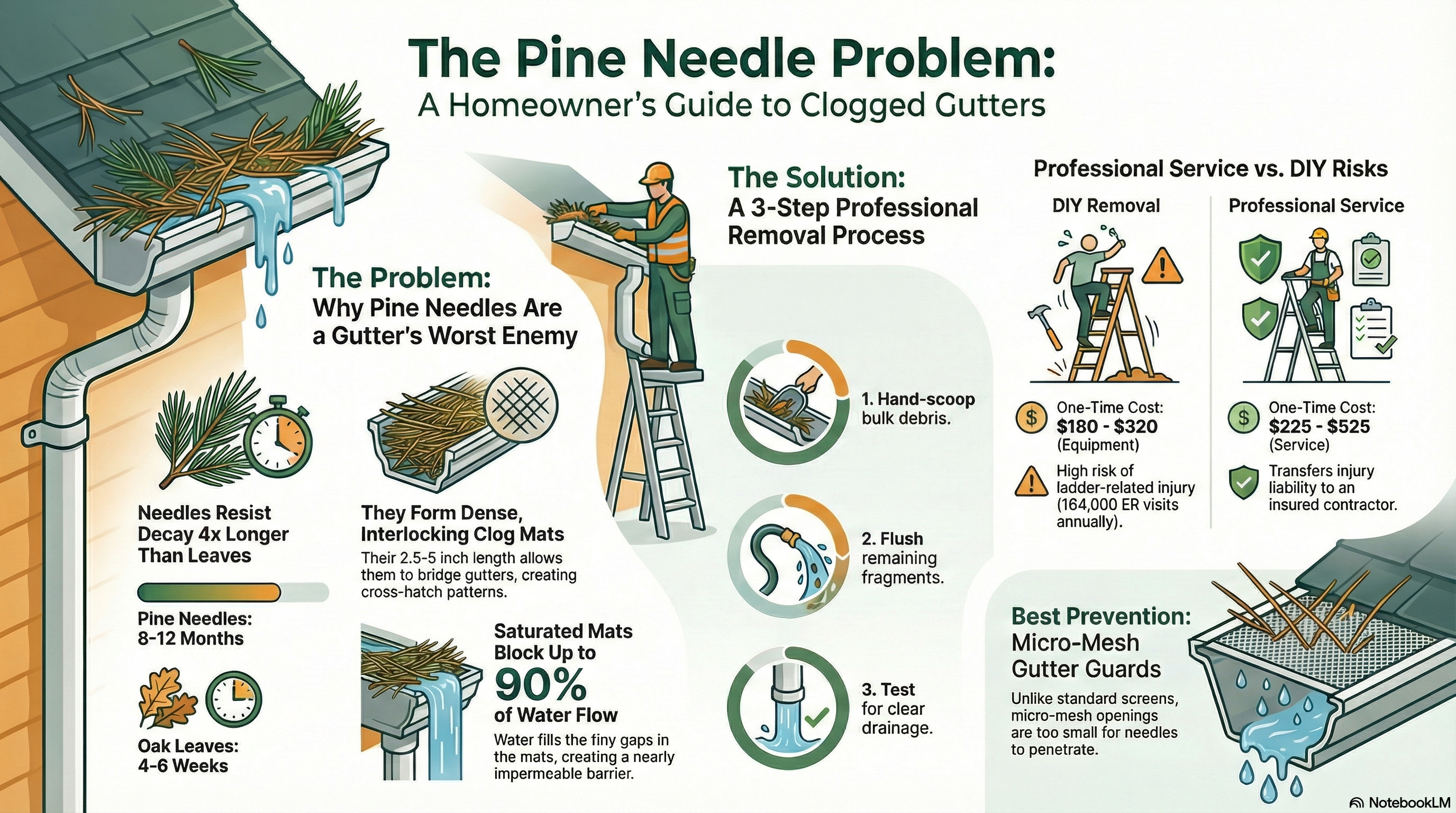
Professional pine needle removal combines manual hand-scooping with our cleaning process to eliminate interlocking mat structures that block 90% of gutter cross-section when saturated.
Eastern White Pine generates 3-4x more gutter debris volume than deciduous trees because needles maintain structural integrity for 8-12 months versus 4-6 weeks for decomposing leaves. Pine needles measure 2.5-5 inches long and create cross-hatch patterns that trap water molecules and resist standard garden hose rinsing at typical residential pressure (40-50 PSI).
Clean Pro's network of vetted service providers removes pine needle accumulations from 100,000+ gutters annually using systematic extraction protocols that prevent downspout blockages and fascia water damage. Professional removal costs $225-$525 for most residential properties under coniferous tree coverage.
Get Instant Quote for Pine Needle Removal →Why Pine Needles Create Persistent Gutter Blockages
Pine needle clogging differs fundamentally from leaf accumulation due to material composition and decomposition resistance. Understanding these physical properties determines effective removal methodology.
Needle Structure and Matting Physics
Eastern White Pine needles contain lignin and cellulose structures that resist microbial breakdown for 8-12 months after shedding. Lignin provides structural rigidity that maintains needle shape during saturation, creating interlocking cross-hatch patterns when multiple needles accumulate in confined gutter channels.
Needle length between 2.5-5 inches allows individual needles to bridge standard 5-inch gutter widths at diagonal angles. Cross-hatching creates mat structures with 75-85% void space when dry, which collapses to 10-15% void space when saturated with rainfall. Water molecules fill remaining voids, creating nearly impermeable barriers that block drainage and overflow gutter capacity.
| Debris Type | Decomposition Period | Mat Formation | Flow Blockage |
|---|---|---|---|
| Pine Needles | 8-12 months | Cross-hatch interlocking | 85-90% |
| Oak Leaves | 4-6 weeks | Loose layering | 60-70% |
| Maple Leaves | 3-4 weeks | Minimal structure | 40-55% |
Seasonal Drop Patterns for Pine Species
Eastern White Pine sheds mature needles continuously from August through November, with peak accumulation in late summer. Needle drop occurs when photosynthetic efficiency declines in older needles, triggering abscission layer formation that releases needles from branch attachment points.
Properties under pine tree coverage require cleaning 3-4 times annually versus 2 times for deciduous coverage. Delaying service beyond 30 days of initial accumulation allows mat formation to progress, increasing removal difficulty and downspout blockage risk.
"The entire process with Clean Pro Gutter Cleaning was very easy. Starting with the online scheduling process to the actual service, this company was very professional and did an excellent job!! I also want to compliment the customer service team for answering all of my questions quickly and with excellent details. My only feedback is that they scheduled my service for a Tuesday but actually performed the service 4 days early on Saturday, which was a surprise and would have been an issue if they were not able to access my property since I was unaware their arrival. Ultimately, everything worked out fine and I will definitely use Clean Pro Gutter Cleaning again!"
— Brad Moulard, Fort Worth, Texas
Required Tools and Safety Equipment
Pine needle extraction requires specialized equipment beyond standard residential cleaning tools. Professional-grade implements prevent incomplete removal and secondary blockages in drainage systems.
⚠️ OSHA Safety Requirements
Standard 1926.1053 (Portable Ladders): Type IA ladders rated for 300-lb capacity with 4:1 angle ratio (1 foot out for every 4 feet up). Rails must extend 3 feet above landing surface for safe transition.
Standard 1926.501 (Fall Protection): Fall protection harnesses become mandatory above 6 feet working height. Personal fall arrest systems require anchorage points rated for 5,000-lb loads.
Biological Hazard Protection: Decomposing pine needles harbor Histoplasma capsulatum fungal spores causing respiratory infections. Nitrile gloves rated for biological hazards prevent skin contact with contaminated organic matter.
Essential Hand Tools
- Gutter scoop with serrated edge: Serrations break mat structures by catching individual needles during extraction. Standard smooth-edge scoops slide over compacted mats without penetrating needle layers.
- 5-gallon contractor-grade bucket: Capacity handles typical single-story extraction volume (8-12 pounds wet weight per 50 linear feet). Bucket placement on stable ladder shelf prevents debris spillage during descent.
- Type IA extension ladder: 300-lb capacity rating accommodates worker weight plus tool load and debris mass. Fiberglass construction prevents electrical conductivity near power lines.
- Nitrile gloves (8-mil thickness): Biological hazard rating protects against fungal spore exposure and potential rodent contamination in accumulated debris.
- Safety glasses with side shields: ANSI Z87.1 rating protects against debris ejection during hand-scooping and debris clearing operations.
Professional Downspout Clearing Equipment
Standard residential garden hoses deliver 40-50 PSI at typical municipal water pressure, insufficient for dislodging compacted needle fragments from downspout elbows and underground drain connections. Professional equipment and techniques break apart these compacted plugs and restore drainage.
Pressure washers rated above 2,000 PSI risk damaging gutter seams and fascia boards through excessive force. Properly calibrated professional clearing dislodges needles without structural damage to aluminum or vinyl gutter materials.
Step-by-Step Pine Needle Removal Process
Systematic removal prevents incomplete extraction and downstream blockages. Each step addresses specific challenges posed by needle mat structures and decomposition products.
Step 1: Establish Safe Ladder Positioning
- To prevent equipment failure during ascent, select Type IA ladder with 300-lb capacity rating. Verify load plate confirms ANSI certification and weight limits. Inspect for cracks, bent rails, or damaged rungs before ascent.
- To establish stable working position, position ladder at 4:1 angle ratio. Measure ladder base distance from structure as one-quarter of working height. Example: 16-foot working height requires 4-foot base distance from gutter line.
- To provide safe transition between ladder and roof edge, extend rails 3 feet above landing surface. Upper section protrusion creates handholds for controlled movement during position changes.
- To verify positioning security before tool loading, test stability by applying downward pressure on middle rung. Movement or flexing indicates unstable positioning requiring adjustment before debris extraction begins.
Step 2: Manual Needle Extraction
- To prevent downstream compaction during clearing, begin extraction at downspout outlets. Heaviest debris accumulations concentrate near drainage points where needle flow stagnates. Clearing outlets first ensures unobstructed drainage during subsequent downspout work.
- To break interlocking mat structures, use serrated scoop inserted beneath needle layer at 45-degree angle. Serrations catch individual needles and separate cross-hatch patterns during lifting motion, achieving complete extraction impossible with smooth-edge tools.
- To prevent debris re-entry during wind events, scoop extracted material into bucket mounted on ladder shelf. Immediate transfer eliminates wind dispersion risk. Bucket placement on stable shelf eliminates descent requirements until capacity fills.
- To prepare gutters for downspout clearing, remove 75-80% of visible debris mass through hand extraction. Complete manual removal beforehand prevents downstream clogging. Residual fragments require water pressure for dislodgement from gutter seams and corners.
Professional service providers remove approximately 8-12 pounds of wet pine needle mass per 50 linear feet of gutter on properties under mature Eastern White Pine coverage. Debris weight varies based on accumulation period and recent rainfall saturation.
Step 3: Downspout Clearing
- To ensure adequate clearing capability, set up equipment at the exterior access point and confirm the work area is ready. Preparation before starting prevents equipment underperformance. Poor setup reduces clearing effectiveness and extends service duration.
- To force debris toward drainage exit rather than compacting against closed end caps, insert nozzle at gutter terminus opposite downspout. Starting point furthest from drainage outlet creates directional flow that pushes needle fragments toward removal points.
- To dislodge compacted needle fragments without damaging gutter structure, apply 80-120 PSI water pressure in sweeping motion concentrated at gutter bottom. Jet flow targets accumulation zones where fragments settle. Avoiding pressure at seams or hangers prevents structural damage to aluminum or vinyl materials.
- To confirm complete blockage removal, verify water exits ground-level termination within 3-5 seconds of nozzle activation at all downspout outlets. Immediate drainage confirms unobstructed flow path. Delayed drainage indicates persistent blockages requiring additional clearing or mechanical augering.
Step 4: Vertical Drainage Check
Clean Pro's Vertical Flow Test protocol confirms complete drainage restoration and identifies hidden blockages in underground drain connections. Service providers pour 2 gallons of water directly into each downspout opening while monitoring exit flow at ground level.
Proper drainage produces continuous stream exit within 3 seconds of water entry at upper opening. Gurgling sounds, intermittent flow, or complete stoppage indicates remaining needle fragments in elbow joints or underground drain sections requiring mechanical augering.
"I am so pleased with this Gutter Cleaning service. Never thought I would be so excited about Gutter Cleaning. This was not an In-N-Out, these guys really took the time to clean the leaves out of the gutters."
— Theodore Newman
Common Pine Needle Removal Mistakes
Incomplete extraction and improper technique create persistent drainage problems despite apparent debris removal. Understanding failure modes prevents recurring blockages and secondary damage.
Mistake 1: Skipping Downspout Clearing
Hand-scooping removes 75-80% of visible needle mass from horizontal gutter channels but cannot access vertical downspout sections where needles accumulate during rainfall events. Needle fragments wash into downspouts during initial cleaning efforts, creating concentrated blockages at elbow joints 6-8 feet below gutter line.
Garden hose rinsing at standard 40-50 PSI lacks sufficient force to dislodge compacted needle plugs from elbow transitions. Professional downspout clearing breaks needle bonds and restores complete vertical drainage to underground termination points.
Mistake 2: Using Leaf Blowers for Pine Needles
Leaf blowers generate 150-200 MPH air velocity effective for dry leaf removal but fail against saturated pine needle mats. Needle moisture content after rainfall events reaches 60-70% by weight, creating dense masses resistant to air displacement.
Blower air streams slide over wet needle surfaces without penetrating mat structures. Attempting blower extraction scatters loose surface needles while leaving compacted lower layers intact, creating incomplete removal that requires repeat service within 30-45 days.
Mistake 3: Delaying Service Past 60 Days
Fresh needle accumulations within 30 days of initial drop maintain loose structure with 75-85% void space, allowing relatively simple hand extraction. Accumulations exceeding 60 days undergo compression from additional needle layers and rainfall saturation, reducing void space to 10-15% and forming dense mats requiring 40-60% more extraction time.
Delayed service also allows biological film development as decomposing needles create organic substrate for microbial growth. Biofilm bonds needle fragments to gutter surfaces, requiring mechanical scraping beyond standard hand-scooping protocols.
Professional vs. DIY Pine Needle Removal
Pine needle extraction presents distinct safety and effectiveness challenges compared to standard leaf cleaning. Evaluating professional service benefits requires understanding specific risk factors and technical requirements.
Safety Risk Analysis
Consumer Product Safety Commission data from the National Electronic Injury Surveillance System documents approximately 164,000 ladder-related emergency room visits annually in residential settings. Fall injuries from gutter cleaning operations represent 18-22% of total ladder incidents, with average medical costs of $17,000-$41,000 for fracture treatment.
Pine needle removal requires 2-3x longer ladder work duration than leaf cleaning due to mat extraction difficulty and downspout clearing requirements. Extended duration on ladders increases fatigue and balance loss risk, particularly on second-story applications requiring 20+ foot working heights.
Professional service providers maintain $1 million general liability insurance coverage and follow OSHA fall protection protocols, transferring injury liability from homeowners to licensed contractors. To learn more about professional safety equipment and insurance verification protocols, review our comprehensive comparison of professional versus DIY gutter cleaning methods.
Equipment Investment Requirements
DIY pine needle removal requires minimum equipment investment of $180-$320 for adequate safety and effectiveness:
- Type IA extension ladder (16-24 feet): $120-$220 for fiberglass models rated for 300-lb capacity
- Pressure washer: $80-$150 for electric models delivering 80-120 PSI at downspout nozzle
- Fall protection harness and anchor: $60-$120 for ANSI-certified systems rated for 5,000-lb anchorage loads
- Nitrile gloves, safety glasses, gutter scoop: $15-$25 for biological hazard-rated personal protective equipment
Professional service costs $225-$525 for typical residential properties, eliminating equipment investment and providing insured liability protection. Homeowners requiring only 1-2 annual cleanings pay less through professional service than equipment ownership over 3-5 year planning horizons.
Preventing Future Pine Needle Accumulation
Permanent debris exclusion systems eliminate recurring pine needle removal requirements while maintaining complete water flow capacity during rainfall events. Understanding protection system design differences determines effectiveness under coniferous tree coverage.
Why Screen Guards Fail Under Pine Trees
Traditional screen guards feature 0.25-0.50 inch perforations allowing water entry while blocking larger debris. Pine needles measuring 2.5-5 inches long bridge perforation gaps and create surface mats that rest atop screen material rather than falling through openings.
Surface mat accumulation diverts water flow over gutter front edge through overflow, defeating the purpose of gutter systems entirely. Screen guards require seasonal surface cleaning to remove needle mats, providing no labor reduction compared to open gutter maintenance.
Mesh Protection Technology
Clean Pro Guard mesh systems feature 990-micron openings (0.039 inches) manufactured from surgical-grade 304 stainless steel. Microscopic perforation size prevents pine needle penetration while maintaining 98% water flow efficiency through surface tension principles.
Water molecules adhere to mesh surface through cohesive forces and flow through perforations via capillary action. Pine needles lack molecular adhesion to stainless steel surfaces and slide off mesh at rainfall contact, preventing mat formation and maintaining continuous drainage capacity.
Professional installation costs $22.50 per linear foot for complete system with lifetime no-clog warranty. Properties under mature pine coverage require stainless mesh protection to eliminate bi-annual or quarterly cleaning expenses that total $470-$1,050 annually. For detailed analysis of guard system performance under pine tree coverage, review our testing data comparing micro-mesh versus alternative protection methods for pine needle exclusion.
"Outstanding service.I was notified 1 hour before their arrival and both of them were very friendly and they did a great job. I would definitely use them again."
— Richard Dobson, New Albany, IN
Specialized Pine Needle Removal Scenarios
Certain property configurations and tree species present unique removal challenges beyond standard residential applications. Understanding complexity factors informs service requirements and cost expectations.
Multi-Story Homes with Mature Pine Coverage
Three-story properties under Eastern White Pine require extended ladder positioning at 28-32 foot working heights, triggering mandatory fall protection harness requirements per OSHA Standard 1926.501. Harness installation adds 15-20 minutes per elevation change, extending total service duration by 40-60% compared to single-story applications.
Debris volume increases proportionally with roof surface area, with three-story homes generating 12-18 pounds of wet needle mass per 50 linear feet versus 8-12 pounds for single-story structures. Professional service costs $425-$625 for three-story pine needle removal reflecting extended duration, fall protection requirements, and increased debris disposal mass.
Longleaf Pine and Slash Pine Species
Longleaf Pine produces needles measuring 8-18 inches in length, exceeding Eastern White Pine by 3-4x. Extended needle length creates more complex mat structures requiring specialized extraction techniques and 25-35% longer hand-scooping duration.
Slash Pine generates resinous sap compounds that coat needles and create adhesive bonding to gutter surfaces during decomposition. Resin removal requires citrus-based solvents applied during extraction process, adding $40-$75 to standard service costs for solvent application and extended scrubbing requirements.
Historic Properties with Built-In Box Gutters
Built-in box gutters integrate into roof structure rather than mounting to fascia boards, creating confined channels difficult to access with standard hand tools. Pine needle extraction from box gutters requires specialized narrow scoops and roof access protocols that respect historic preservation guidelines.
Historic commissions in designated districts mandate specific debris disposal procedures and prohibit pressure washing that might damage original materials. Service costs reach $470-$750 for historic properties due to specialized access requirements, preservation protocol compliance, and extended extraction duration in confined gutter channels.
Related Home Maintenance Cost Guides
Pine needle removal represents one component of comprehensive exterior drainage system maintenance. Professional service providers in Clean Pro's network also connect homeowners with specialists for related coniferous tree damage prevention:
- Pine sap removal from siding costs $175-$425 for pressure washing with specialized citrus solvents that break resinous bonds without damaging painted surfaces
- Tree pruning to reduce needle drop costs $200-$600 for selective limb removal above roofline perimeters, reducing debris volume by 40-60% annually (review optimal cleaning frequency schedules for properties with varying tree coverage densities)
- Fascia board replacement from pine needle water damage costs $8-$18 per linear foot when overflow from clogged gutters penetrates wood substrate and causes rot progression
- Professional gutter guard installation costs $18-$40 per linear foot depending on system complexity. Clean Pro Guard provides firm quotes at $22.50/ft while national guard companies typically require in-home sales consultations (compare one-time micro-mesh guard installation versus recurring bi-annual pine needle removal expenses)
Preventive pine needle removal costs $225-$525 quarterly to avoid the four-figure fascia replacement and foundation repair bills that result from neglected drainage systems under coniferous tree coverage.
Regional Pine Needle Removal Service Coverage
Coniferous tree coverage creates persistent debris challenges requiring quarterly or bi-annual professional extraction across pine-dominant climate zones. Clean Pro's certified service providers specialize in micro-mesh mat removal and downspout clearing techniques specific to pine needle accumulation patterns.
Pacific Northwest and Mountain Pine Zones
Douglas Fir and Ponderosa Pine species dominate Pacific Northwest landscapes, dropping 8-12 pounds of needles per 50 linear feet annually. Professional quarterly cleaning in Seattle, Denver, and surrounding mountain communities prevents mat formation during wet-season months (October-March) when needle decomposition accelerates and creates downspout blockages requiring professional clearing.
Southeastern Pine Belt Service Areas
Longleaf Pine and Loblolly Pine coverage in southeastern markets generates needle debris year-round due to mild winter temperatures preventing dormancy cycles. Bi-annual professional extraction serves Charlotte, Atlanta, and Nashville, scheduling spring and fall service appointments timed to peak needle drop seasons (March-April and September-October) when accumulation rates exceed 6 pounds per 50 linear feet monthly.
Request your 15-minute quote for professional pine needle extraction with downspout clearing and flow verification.
Schedule Professional Pine Needle Removal
Clean Pro's network of vetted service providers removes pine needle accumulations from residential gutters in 42 states nationwide. Satellite-based quoting provides instant pricing without 3-7 day in-home estimate delays.
Independent contractors in Clean Pro's network maintain $1 million general liability insurance and follow systematic extraction protocols combining hand-scooping with downspout clearing. Service includes complete debris disposal, downspout flow verification, and before/after photographic documentation confirming drainage restoration.
Get Instant Quote for Your Property →Properties under Eastern White Pine, Longleaf Pine, or Slash Pine coverage benefit from quarterly service schedules that prevent mat formation and maintain continuous water flow capacity during rainfall events. Clean Pro coordinates timing based on regional needle drop patterns and accumulation forecasting.