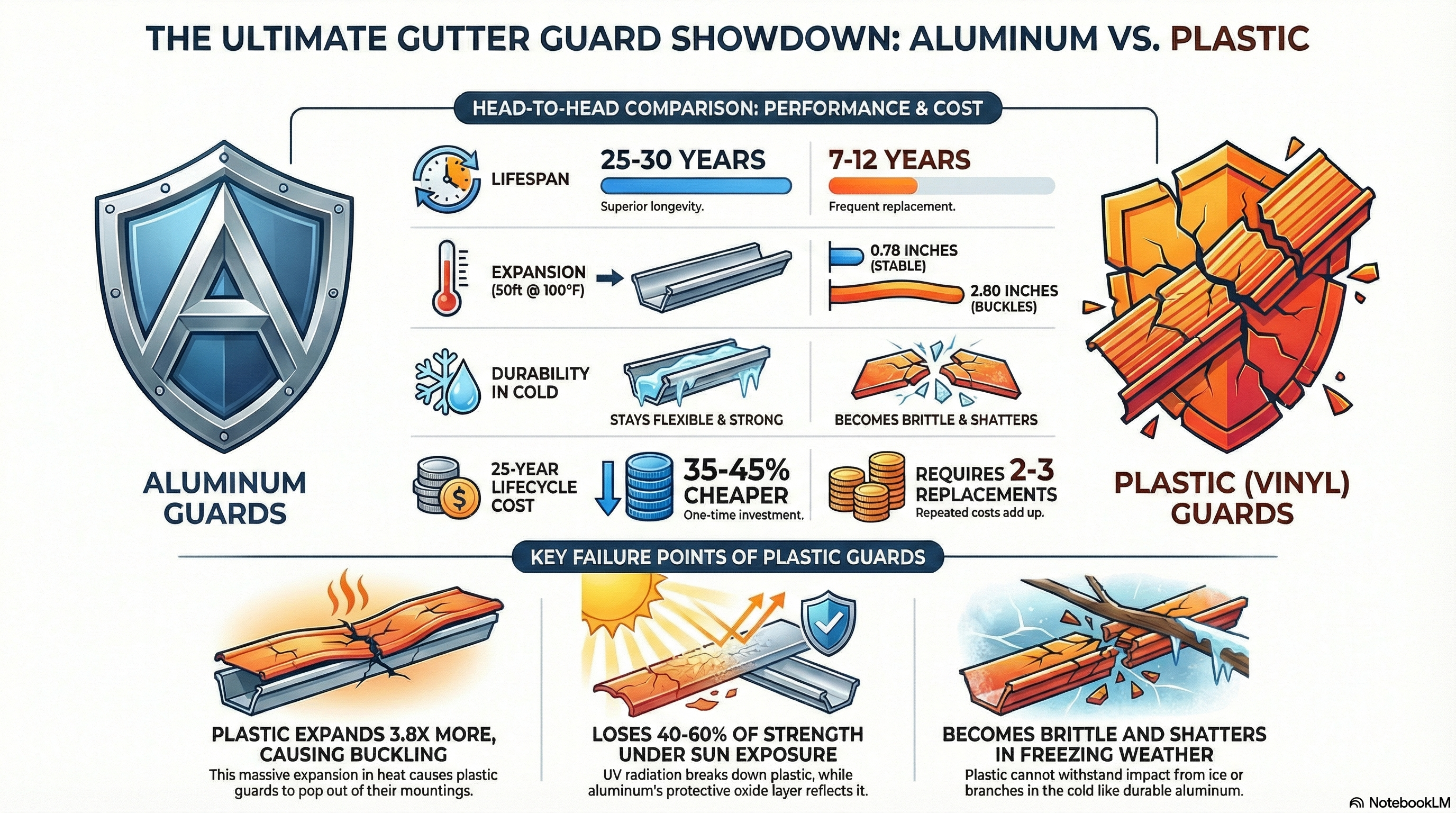
Aluminum gutter guards withstand freeze-thaw cycles 3.8 times better than plastic vinyl guards due to differential thermal expansion rates. Over 50 linear feet with a 100°F temperature swing, aluminum expands 0.78 inches while vinyl expands 2.80 inches, causing plastic systems to buckle out of mounting brackets during seasonal temperature changes.
Material selection determines gutter guard lifespan more than any other factor. Homeowners installing plastic guards save $2-8 per linear foot upfront but replace the entire system 2-3 times over 25 years. Aluminum guards cost $4.50-$40 per foot installed but last 25-30 years without structural degradation, making aluminum 35-45% cheaper over the product's service life.
The following comparison analyzes thermal expansion physics, UV degradation rates, impact resistance, and lifecycle costs to determine which material delivers better value for different climates and installation scenarios.
Get Your Instant Quote (30 Seconds)Material Science: Thermal Expansion Rates Determine Structural Stability
Why does thermal expansion matter for gutter guard performance?
Thermal expansion coefficients measure how much materials grow or shrink with temperature changes. Aluminum expands at a rate of 13 × 10⁻⁶ inches per inch per °F while vinyl plastic expands at 50 × 10⁻⁶ inches per inch per °F—a 3.8x difference that creates measurable dimensional changes across typical roof spans.
Standard residential homes carry 150-200 linear feet of rain gutters. Summer attic temperatures reach 130-160°F in direct sun while winter ambient temperatures drop to -10°F to 20°F in northern climates. The 100-140°F temperature delta generates predictable expansion and contraction forces that stress mounting systems differently based on material choice.
Calculating Real-World Dimensional Changes
Material expansion follows the formula: ΔL = α × L₀ × ΔT, where ΔL represents dimensional change, α denotes the thermal expansion coefficient, L₀ equals original length, and ΔT shows temperature change.
| Material | Expansion Coefficient | 50ft @ 100°F Delta | 150ft @ 100°F Delta |
|---|---|---|---|
| Aluminum | 13 × 10⁻⁶ in/in/°F | 0.78 inches | 2.34 inches |
| Vinyl Plastic | 50 × 10⁻⁶ in/in/°F | 2.80 inches | 9.00 inches |
| Dimensional Mismatch | 3.8x difference | 2.02 inches | 6.66 inches |
Vinyl guards installed on 150-foot rooflines expand 9 inches more than aluminum during summer heat cycles. Mounting clips and fascia brackets cannot accommodate the 6.66-inch differential movement without plastic sections buckling, popping out, or cracking at fastener holes. Aluminum systems distribute the 2.34-inch expansion evenly across mounting points without exceeding bracket tolerances.
Freeze-Thaw Cycling: Material Ductility Below 32°F
What happens to plastic and aluminum during winter freeze-thaw cycles?
Ductility measures a material's ability to deform without fracturing. Aluminum maintains ductile properties to -80°F while vinyl plastic transitions to brittle behavior below 32°F. Winter ice formation exerts 208 tons per square inch of expansion force, exceeding the tensile strength of cold-brittle vinyl but remaining below aluminum's yield threshold.
Vinyl guards undergo 40-100 freeze-thaw cycles annually in northern climates. Each cycle weakens molecular bonds through micro-crack propagation. Aluminum forms a protective oxide layer that prevents crack initiation, maintaining structural integrity through unlimited freeze-thaw cycles.
Impact Resistance During Winter Storms
| Property | Aluminum Guards | Plastic Vinyl Guards |
|---|---|---|
| Tensile Strength (New) | 45,000 PSI | 7,500 PSI |
| Tensile Strength (8-Year UV) | 45,000 PSI (no change) | 3,000-4,500 PSI (-40% to -60%) |
| Ductility Below 32°F | Maintained | Brittle |
| Hail Impact Resistance | 1.5-inch diameter | 0.75-inch diameter |
| Branch Impact Recovery | Springs back | Cracks/shatters |
Falling ice, hail stones, and tree branches strike gutter systems during winter storms. Aluminum guards absorb impact energy through elastic deformation and return to original shape. Vinyl guards shatter on impact after UV degradation reduces tensile strength below critical thresholds for brittle fracture.
UV Degradation: Photodegradation Rates Under Direct Sunlight
How does sunlight damage plastic guards compared to aluminum?
Ultraviolet radiation breaks polymer chains in vinyl plastic through photodegradation. Direct sunlight delivers 280-400 nanometer UV wavelengths that cleave carbon-carbon bonds, reducing molecular weight and tensile strength by 40-60% within 8-10 years of continuous exposure.
Aluminum forms an inert aluminum oxide surface layer that reflects UV radiation without chemical degradation. The oxide layer self-repairs when scratched, providing permanent UV protection. Vinyl requires UV stabilizer additives that deplete over time, leaving base polymer vulnerable to photochemical breakdown.
Service Life Comparison Across Sun Exposure Levels
| Sun Exposure Level | Aluminum Service Life | Vinyl Service Life |
|---|---|---|
| North-Facing (Minimal) | 25-30 years | 10-12 years |
| East/West-Facing (Moderate) | 25-30 years | 8-10 years |
| South-Facing (Maximum) | 25-30 years | 7-9 years |
| Desert Climate (Intense) | 25-30 years | 5-7 years |
South-facing gutters receive 6-8 hours of direct sunlight daily during summer months. Vinyl guards on south-facing rooflines fail 2-3 years earlier than north-facing installations due to accelerated UV exposure. Aluminum performance remains constant regardless of sun orientation or climate intensity.
Weight and Structural Load: Self-Supporting vs. External Bracing
Which material weighs less, aluminum or plastic vinyl?
Material density determines structural load transmitted to fascia boards and gutter hangers. Aluminum weighs 0.098 pounds per cubic inch while vinyl weighs 0.050 pounds per cubic inch. However, vinyl requires thicker cross-sections to achieve equivalent strength, negating the density advantage.
Professional-grade aluminum guards use 0.019-inch thick frames that span 12-18 inches between mounting points without sagging. Vinyl guards require 0.040-0.060-inch thickness and 8-12-inch mounting intervals to prevent mid-span deflection under wet debris loads.
Fascia Load Analysis Per 100 Linear Feet
| Component | Aluminum System Weight | Vinyl System Weight |
|---|---|---|
| Guard Material | 18 lbs | 12 lbs |
| Mounting Hardware | 6 lbs | 9 lbs (more brackets needed) |
| Wet Debris (Typical) | 45 lbs | 45 lbs |
| Total Static Load | 69 lbs | 66 lbs |
Vinyl's lower material density creates negligible weight advantage once installation density and structural thickness requirements factor into total system mass. Aluminum's superior strength-to-weight ratio permits wider mounting spans that reduce fascia penetrations and installation labor.
Lifecycle Cost Analysis: Material Replacement Frequency
Which material costs less over 25 years of ownership?
Initial purchase price favors vinyl guards at $2.00-$4.00 per linear foot for DIY materials. Professional aluminum systems cost $18-$40 per foot installed. However, replacement frequency determines total cost of ownership over typical 25-30 year homeownership periods.
Vinyl guards require full replacement every 7-12 years as UV degradation and thermal cycling compromise structural integrity. Aluminum guards last 25-30 years without replacement, eliminating secondary installation costs and material waste.
25-Year Total Cost Comparison (150 Linear Feet)
| Cost Component | Aluminum Guards | Vinyl Guards |
|---|---|---|
| Initial Installation | $3,375 ($22.50/ft × 150ft) | $675-$1,800 (DIY or basic pro) |
| Replacement #1 (Year 8-10) | $0 | $675-$1,800 |
| Replacement #2 (Year 16-20) | $0 | $675-$1,800 |
| Professional Cleaning (25 years) | $4,975-$11,250 ($218-$470 × 25) | $4,975-$11,250 (same frequency) |
| 25-Year Total Cost | $8,350-$14,625 | $7,000-$16,650 |
| Cost Per Year | $334-$585 | $280-$666 |
Aluminum guards deliver predictable annual costs of $334-$585 with no replacement uncertainty. Vinyl guards cost $280-$666 annually with replacement timing dependent on sun exposure, climate severity, and initial product quality. High-quality vinyl approaches aluminum's lifecycle cost while delivering inferior performance and requiring disposal/reinstallation logistics every 8-10 years.
"Ashley was very careful , paid attention to detail, and did a GREAT job !"Schedule Professional Guard Installation
— Jan Southall, Raleigh, NC
Material Performance in Extreme Weather Conditions
Which material performs better in extreme climates?
Regional climate determines material suitability more than brand reputation or marketing claims. Aluminum performs consistently across all U.S. climate zones while vinyl exhibits location-specific failure modes that accelerate degradation in certain environments.
Desert Southwest (Arizona, Nevada, Southern California)
UV intensity reaches 8-10 on the UV Index during summer months, delivering 280-400nm wavelengths that degrade vinyl 40-60% faster than moderate climates. Surface temperatures exceed 160°F on dark roofing materials, creating 130-140°F temperature swings between night and day.
Vinyl guards in Phoenix or Las Vegas fail within 5-7 years as combined UV exposure and thermal cycling exceed material design limits. Aluminum guards withstand desert conditions for 25-30 years without performance degradation, making aluminum the economically rational choice despite higher upfront costs.
Northern Freeze Zones (Minnesota, Wisconsin, Michigan)
Ambient temperatures drop to -20°F to -40°F during polar vortex events while summer attic temperatures reach 130-150°F—creating 170-190°F annual temperature range. Vinyl loses ductility below 32°F and becomes susceptible to impact damage from ice dams, falling icicles, and snow loading.
Freeze-thaw cycling occurs 60-100 times per winter season. Each cycle propagates micro-cracks through vinyl matrix, reducing tensile strength and impact resistance. Aluminum maintains ductility to -80°F and resists embrittlement through unlimited freeze-thaw cycles.
Coastal Humidity Zones (Gulf Coast, Atlantic Seaboard)
Salt spray accelerates corrosion in unprotected aluminum but has minimal effect on vinyl chemistry. Marine-grade aluminum alloys (6063-T5 or better) form protective oxide layers that resist salt corrosion. Standard vinyl formulations resist salt spray without degradation.
Coastal installations favor aluminum systems specified with marine-grade alloys and stainless steel fasteners. Vinyl's corrosion resistance advantage disappears when UV degradation limits service life to 8-12 years regardless of salt exposure.
Installation Complexity and Mounting System Compatibility
Is aluminum or plastic easier to install professionally?
Aluminum guards accommodate both fascia-mount and under-shingle mounting configurations. Vinyl systems typically require fascia-mount installation due to thermal expansion constraints that prevent secure under-shingle integration.
Under-shingle mounting eliminates visible fasteners and distributes load across roof structure rather than concentrating forces on fascia boards. Aluminum's dimensional stability permits under-shingle installation without creating roof penetration stress from thermal cycling.
Mounting Configuration Comparison
| Mounting Type | Aluminum Compatibility | Vinyl Compatibility |
|---|---|---|
| Fascia Mount | Excellent - Minimal expansion stress | Good - Requires expansion gaps |
| Under-Shingle Mount | Excellent - Stable across temp range | Poor - Expansion lifts shingles |
| Bracket Spacing | 12-18 inches | 8-12 inches (prevents sagging) |
| Roof Warranty Impact | None with proper installation | Possible void if expansion damages shingles |
Vinyl's 2.80-inch expansion over 50 feet creates shingle stress when installed under roofing materials. Aluminum's 0.78-inch expansion remains within tolerance for under-shingle mounting without compromising roof warranties or creating water intrusion pathways.
Professional vs. DIY Installation: Material-Specific Considerations
Which material is more forgiving for DIY installation errors?
Vinyl guards market heavily toward DIY installation due to low material costs and snap-together assembly. However, achieving proper thermal expansion gaps and bracket spacing requires understanding dimensional change calculations and climate-specific installation protocols. Aluminum guards tolerate installation errors better due to lower thermal expansion rates but require specialized fasteners and proper pitch verification.
DIY vinyl installations commonly fail prematurely due to inadequate expansion gaps, excessive bracket spacing, or mounting configurations that constrain thermal movement. Professional installers account for regional temperature ranges and adjust mounting specifications to accommodate material expansion characteristics.
Common DIY Installation Errors by Material Type
- Vinyl guards fail when DIY installers omit expansion gaps between sections, causing buckled panels during summer heat
- Vinyl guards fail when bracket spacing exceeds 10 inches, permitting mid-span sag under wet debris loads
- Aluminum guards fail when DIY installers use incompatible fasteners that create galvanic corrosion between dissimilar metals
- Aluminum guards fail when improperly pitched installations create water ponding that exceeds drainage capacity
Professional installation eliminates material-specific failure modes through proper fastener selection, expansion gap sizing, and pitch verification. Clean Pro Guard systems specify marine-grade 304 stainless steel mesh with aluminum frames rated for 150-foot spans without intermediate support requirements.
Hybrid Material Systems: Combining Aluminum Frames with Alternative Mesh
Can plastic guards use hybrid material construction?
Premium guard systems use aluminum structural frames with stainless steel or copper mesh to optimize corrosion resistance and debris filtration. The aluminum frame provides dimensional stability while mesh material determines filtration aperture and corrosion characteristics. Plastic vinyl guards cannot support hybrid construction because thermal expansion differences between vinyl frames and metal mesh create joint failures at connection points.
Clean Pro Guard technical specifications combine 0.019-inch aluminum frames with 304 surgical-grade stainless steel mesh rated at 990 microns. The hybrid construction delivers aluminum's thermal stability with stainless steel's superior corrosion resistance and filtration efficiency.
Material Combination Performance Matrix
| Frame Material | Mesh Material | Service Life | Cost Premium |
|---|---|---|---|
| Aluminum | Aluminum | 20-25 years | Baseline |
| Aluminum | Stainless Steel | 25-30 years | +15-25% |
| Aluminum | Copper | 30+ years | +40-60% |
| Vinyl | Vinyl/Polymer | 7-12 years | -60-75% |
Stainless steel mesh adds $3.00-$5.00 per linear foot to aluminum frame costs but extends service life 5-10 years through superior corrosion resistance. The 15-25% cost premium delivers 25-40% longer service intervals, improving lifecycle value over aluminum-only systems.
Specialized Scenarios: When Vinyl Guards May Be Appropriate
When should homeowners choose vinyl over aluminum?
Vinyl guards serve legitimate applications in specific scenarios where low initial cost and short-term protection outweigh lifecycle value considerations. Aluminum remains the optimal choice for long-term ownership, but vinyl delivers temporary solutions for budget-constrained situations.
Temporary Property Ownership
Homeowners planning to sell within 3-5 years gain curb appeal benefits from vinyl guard installation at $2.00-$4.00 per foot without investing in 25-year aluminum systems. The visual improvement and "maintenance-free gutter" marketing claim support sale price justification without requiring long-term performance validation.
Rental Property Cash Flow Management
Property investors managing cash flow constraints benefit from vinyl's lower upfront cost despite higher replacement frequency. The $300-$600 installation cost preserves capital for higher-priority repairs while providing tenant-facing gutter protection that reduces maintenance calls.
Mild Climate Installations
Pacific Northwest homes in Seattle or Portland experience minimal UV intensity and narrow temperature ranges (40-90°F annual swing). Vinyl guards last 10-12 years in mild climates approaching aluminum's service life in harsh environments, narrowing the lifecycle cost advantage that favors aluminum in extreme weather zones.
Material Selection Decision Framework
Choosing between plastic and aluminum guards requires evaluating climate severity, ownership timeline, and total cost of ownership rather than initial purchase price alone.
Select Aluminum Guards If:
- Temperature range exceeds 120°F annually (northern freeze zones or desert climates)
- UV index averages 7+ during summer months (southern or high-altitude locations)
- Homeownership timeline exceeds 10 years (lifecycle cost favors aluminum after second vinyl replacement)
- Under-shingle mounting required to preserve roof warranties or aesthetic preferences
- Fascia boards show deterioration requiring minimal additional penetrations
Consider Vinyl Guards If:
- Sale planned within 3-5 years (upfront cost minimization takes priority)
- Mild climate zone with 60-100°F temperature range and UV index below 6
- Cash flow constraints limit capital available for gutter protection investment
- North-facing gutters minimize UV exposure extending vinyl service life to 10-12 years
Regional climate and ownership timeline determine material selection more than brand reputation or marketing claims. Aluminum delivers superior value in harsh climates and long-term ownership scenarios while vinyl serves short-term applications and mild environments where UV degradation and thermal cycling remain below critical failure thresholds.
Regional Aluminum Guard Installation Coverage by Climate Zone
Clean Pro Guard's aluminum-framed mesh systems deliver superior thermal stability and UV resistance across extreme climate conditions. Professional installation networks provide surgical-grade 304 stainless steel mesh with 0.019-inch aluminum frames rated for temperature ranges from -80°F to +140°F without structural degradation.
Extreme UV and Desert Climate Protection
Southern and southwestern markets experiencing UV index 8-11 during peak summer months require aluminum construction resisting photodegradation that causes vinyl guard failure within 7-8 years. Professional aluminum guard installation serves Dallas, Houston, Atlanta, Charlotte, and Nashville, providing 25-30 year service life in high-intensity solar radiation zones where plastic systems degrade to 40-60% tensile strength within 8-10 years.
Northern Freeze-Thaw Cycle Resistance
Northern climate markets facing 100-140°F annual temperature swings require aluminum's superior thermal stability preventing bracket failure and dimensional mismatch. Certified installation teams in Boston, New York, Philadelphia, Chicago, St Louis, and Denver install aluminum systems maintaining ductility to -80°F preventing brittle fracture from ice impact forces exceeding 208 tons per square inch during winter freeze events.
Pacific Northwest Moderate Climate Installation
Mild climate zones experiencing narrow temperature ranges (40-90°F) and moderate UV index 4-6 benefit from aluminum's 25-30 year service life eliminating replacement cycles required by vinyl systems. Professional installation in Seattle provides aluminum frame construction with stainless steel mesh delivering superior corrosion resistance in high-moisture environments where annual precipitation exceeds 40-60 inches.
Request your 15-minute quote for aluminum-framed mesh guard installation with climate-specific material certifications.
Related Gutter Protection Topics
Material selection represents one component of comprehensive gutter protection strategy. Professional installers in Clean Pro's network also provide guidance on related drainage and material compatibility topics:
- Galvanic corrosion prevention requires matching gutter and guard metals to avoid electrochemical reactions that dissolve aluminum gutters when installed with copper components (understand why you cannot mix copper and aluminum metals in gutter systems)
- Professional guard installation costs $18-$40 per linear foot depending on system complexity. Clean Pro Guard provides firm quotes at $22.50/ft—national guard companies typically require in-home consultations before pricing (review Clean Pro Guard technical specifications and performance data)
- Flow rate capacity determines guard performance during heavy rainfall events. Micro-mesh systems handle 60+ gallons per minute while solid covers experience overflow during 3+ inch per hour storms (compare flow rate specifications and water handling capacity across guard types)
- Maintenance requirements persist despite guard installation. Professional cleaning costs $218-$470 annually to remove surface debris and verify drainage function (calculate annual gutter maintenance costs with and without guard systems)
Preventive guard installation reduces annual cleaning frequency from 2-4 times to 1-2 times while protecting against the $13,954 average water damage claim that results from neglected drainage systems.
Frequently Asked Questions
How much more does aluminum expand than plastic in temperature changes?
Vinyl plastic expands 3.8 times more than aluminum. Over 50 linear feet with a 100°F temperature swing, aluminum expands 0.78 inches while vinyl expands 2.80 inches. The differential expansion causes vinyl guards to buckle and pop out of mounting brackets during freeze-thaw cycles.
Which material lasts longer, plastic or aluminum gutter guards?
Aluminum guards last 25-30 years with minimal degradation. Plastic vinyl guards last 7-12 years before UV brittleness and thermal cycling cause structural failure. Aluminum resists UV radiation indefinitely while plastic photodegrades, losing 40-60% of tensile strength within 8-10 years of sun exposure.
Are plastic gutter guards cheaper than aluminum?
Plastic guards cost $2.00-$4.00 per linear foot for DIY materials while aluminum systems cost $4.50-$12.00 per foot for materials or $18-$40 per foot professionally installed. However, lifecycle cost analysis favors aluminum: plastic requires 2-3 replacements over 25 years versus one aluminum installation, making aluminum 35-45% cheaper over the product's service life.
Can you mix plastic and aluminum gutter guard components?
Mixing plastic and aluminum components creates differential thermal expansion that damages mounting systems. Aluminum expands 0.78 inches over 50 feet while plastic expands 2.80 inches at the same temperature delta, creating 2.02 inches of dimensional mismatch that shears fasteners and cracks mounting holes.
Do plastic gutter guards become brittle in cold weather?
Plastic vinyl guards lose ductility below 32°F, becoming brittle and prone to impact cracking from ice, hail, or falling branches. Aluminum maintains ductility to -80°F and resists impact damage throughout freeze-thaw cycles. Winter ice expansion exerts 208 tons per square inch of force, exceeding the 4,500 PSI tensile strength of degraded vinyl but remaining well below aluminum's 45,000 PSI yield strength.
Get Your Instant Quote - 30 Seconds