Galvanic corrosion destroys aluminum gutter guards installed on copper gutters through electrochemical voltage differences exceeding 0.50V in 2026.
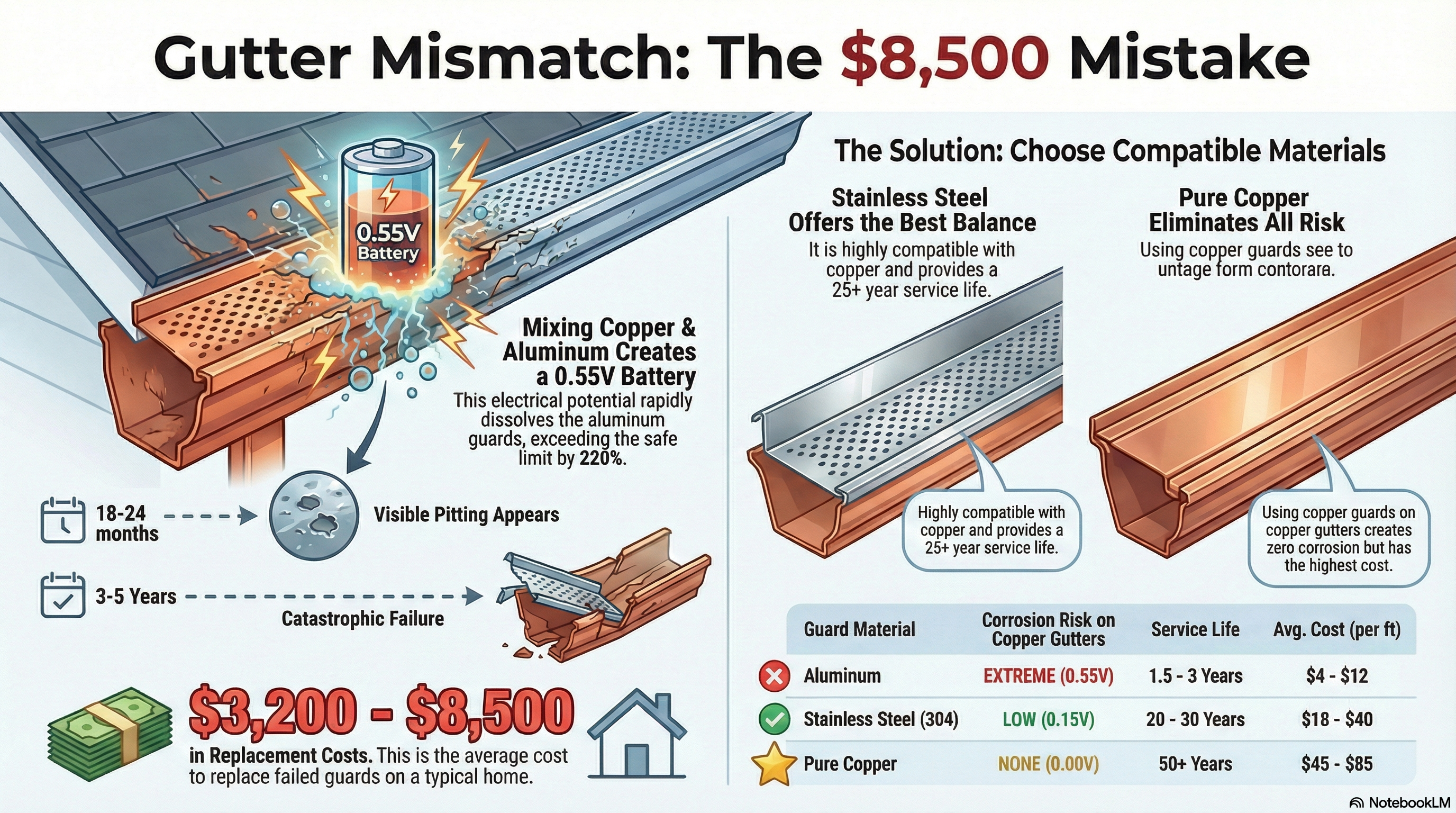
Copper gutters paired with aluminum guards create a 0.55-volt electrochemical battery that accelerates aluminum dissolution through galvanic corrosion, with visible pitting appearing within 18-24 months and complete structural failure occurring in 3-5 years. The anodic index difference between copper (-0.35V) and aluminum (-0.90V) exceeds the 0.25V threshold for rapid corrosion in the presence of moisture and dissolved electrolytes.
Homeowners who schedule gutter guard installations on copper gutter systems must specify stainless steel materials to avoid catastrophic corrosion failure and premature guard replacement costs averaging $3,200-$8,500 for typical residential homes.
Get Free Material Compatibility Analysis →The Electrochemical Battery Effect in Copper-Aluminum Gutter Systems
Copper-aluminum combinations generate measurable electrical voltage when moisture bridges dissimilar metals in direct contact. The electrochemical potential difference between copper's anodic index of -0.35 volts and aluminum's index of -0.90 volts creates a 0.55-volt battery cell that drives accelerated corrosion through electron flow from aluminum (anode) to copper (cathode).
The galvanic series ranks metals by their tendency to corrode when paired with dissimilar materials. Metals separated by more than 0.25 volts on the anodic index exhibit rapid corrosion rates, with the more active metal (lower voltage) sacrificing itself to protect the more noble metal (higher voltage). Aluminum guards on copper gutters create voltage differences of 0.55V—exceeding the failure threshold by 220%.
| Material Combination | Voltage Difference | Corrosion Risk | Failure Timeline |
|---|---|---|---|
| Copper + Aluminum | 0.55V | Extreme | 18-24 months (visible damage) |
| Copper + Galvanized Steel | 0.60V | Extreme | 12-18 months (zinc coating failure) |
| Copper + Stainless Steel (304) | 0.15V | Low | 15-25 years (normal weathering) |
| Copper + Copper | 0.00V | None | 50+ years (oxidation only) |
| Aluminum + Aluminum | 0.00V | None | 25-40 years (normal weathering) |
Rainfall introduces dissolved ions (chlorides, sulfates, nitrates) that increase water conductivity to 50-200 microsiemens per centimeter, accelerating electron transfer rates between dissimilar metals. Coastal environments with salt spray exposure increase corrosion rates by 300-400% compared to inland installations due to elevated chloride ion concentrations that enhance electrical conductivity.
Visible Corrosion Progression: What Homeowners See
Galvanic corrosion progresses through three distinct phases visible to homeowners during routine gutter inspections. Initial surface pitting appears as white powdery deposits (aluminum oxide) concentrated around fastener points where electrical contact intensity peaks. This early-stage corrosion typically manifests within 12-18 months in humid climates with annual rainfall exceeding 35 inches.
Phase 1: Surface Pitting and White Powder Formation (Months 6-18)
Aluminum oxidation generates white aluminum hydroxide powder accumulating around screw holes, mounting brackets, and contact points where copper and aluminum surfaces touch. Homeowners scheduling copper gutter cleaning services often notice chalky white residue during spring maintenance inspections, indicating active galvanic corrosion beneath the surface.
Microscopic analysis reveals pit depths reaching 0.5-1.2 millimeters within the first year of exposure, with corrosion rates accelerating exponentially as pits penetrate protective oxide layers and expose fresh aluminum substrate to moisture and electrolytes.
Phase 2: Structural Weakening and Fastener Failure (Months 18-36)
Corrosion-induced material loss reduces effective material thickness by 30-45% at fastener locations, creating stress concentrations that initiate crack propagation under normal wind loads (15-25 mph gusts). Aluminum guards begin sagging between support points as galvanic dissolution undermines structural integrity at mounting brackets.
Fastener pull-through failures become common during this phase, with corroded aluminum unable to sustain the 15-25 pounds per linear foot design loads specified for micro-mesh gutter guard systems. Wind uplift forces during moderate storms exceed remaining material strength, causing progressive detachment from copper gutter lips.
Phase 3: Complete Structural Failure (Months 36-60)
Advanced galvanic corrosion creates through-holes in aluminum guard frames, allowing debris accumulation and negating the guard's protective function. Material dissolution reaches 60-75% loss at critical stress points, triggering catastrophic failure during snow loading events exceeding 15 pounds per square foot.
Replacement costs for failed aluminum guards on copper gutters average $3,200-$8,500 for typical 200-280 linear foot residential installations, plus additional expenses for copper gutter repair if corrosion byproducts stained or etched the underlying copper surface during the degradation process.
Critical Warning: Some contractors install plastic isolation washers between aluminum guards and copper gutters, claiming this prevents galvanic contact. Moisture infiltration behind washers maintains electrical conductivity through water film interfaces, delaying but not eliminating corrosion. Voltage measurements across "isolated" joints still register 0.40-0.48V potential differences—exceeding the 0.25V failure threshold.
Material Compatibility Guidelines for Copper Gutter Systems
Professional gutter guard installations on copper gutters require materials with anodic indices within 0.20 volts of copper's -0.35V position on the galvanic series. Stainless steel alloys (Type 304, 316) occupy the -0.30V to -0.15V range, creating voltage differences of 0.05-0.20V that fall below the accelerated corrosion threshold.
Surgical-Grade Stainless Steel: The Engineering Solution
Clean Pro Guard uses surgical-grade 304 stainless steel mesh (-0.30V anodic index) that generates only 0.05-volt potential difference when installed on copper gutters. The minimal voltage differential prevents measurable galvanic corrosion while maintaining the structural strength required for 60-gallon-per-minute flow rates during severe storm events.
Type 304 stainless steel contains 18% chromium and 8% nickel, creating a passive chromium oxide surface layer that resists atmospheric corrosion and maintains electrical compatibility with copper substrates over 20-30 year service lives. The 990-micron mesh aperture blocks debris while preventing the water sheeting failures common in solid aluminum guard designs.
| Guard Material | Installed Cost (per linear foot) | Compatibility with Copper | Service Life on Copper Gutters |
|---|---|---|---|
| Aluminum (Big-Box DIY) | $4-$12 | Incompatible (0.55V) | 18-36 months before failure |
| Galvanized Steel | $8-$18 | Incompatible (0.60V) | 12-24 months (zinc coating fails) |
| Stainless Steel (304) | $18-$40 | Compatible (0.05-0.15V) | 20-30 years normal service |
| Clean Pro Guard (304 SS) | $22.50 | Compatible (0.05V) | 25+ years with warranty |
| Pure Copper Guards | $45-$85 | Compatible (0.00V) | 50+ years (identical material) |
| Plastic/PVC Guards | $3-$8 | Compatible (non-conductive) | 5-8 years (UV degradation) |
Clean Pro Guard installations on copper gutters provide firm quotes at $22.50 per linear foot with no in-home consultation required, positioning between unreliable aluminum systems ($4-$12/ft) and premium pure copper guards ($45-$85/ft). National guard companies typically require in-home consultations before pricing stainless steel upgrades, often quoting $30-$50 per linear foot for comparable 304-grade mesh systems.
Pure Copper Guards: Eliminating Galvanic Risk Entirely
Copper mesh guards eliminate galvanic corrosion potential by matching the base metal of copper gutter systems (0.00V voltage difference). Custom-fabricated copper guards cost $45-$85 per linear foot installed due to material expense and specialized fabrication requirements, but deliver 50-75 year service lives matching historical copper gutter installations.
Copper guard patina development mirrors the base gutter system, creating uniform green oxidation (verdigris) over 15-20 years that homeowners often prefer for the aesthetic consistency on historic or high-end architectural installations. The identical thermal expansion coefficients between copper guards and copper gutters (16.5 micrometers per meter per °C) prevent differential movement stresses that cause fastener loosening in mixed-metal systems.
Plastic Guards: Corrosion Immunity with Mechanical Limitations
Non-conductive plastic guards (PVC, polypropylene, polyethylene) provide complete galvanic corrosion immunity when installed on copper gutters, but fail mechanically under snow loads exceeding 15 pounds per square foot. Ultraviolet radiation degrades polymer chain structures, causing embrittlement and cracking within 5-8 years in direct sun exposure typical of unshaded south-facing roof sections.
Thermal expansion coefficients for plastic materials (60-200 micrometers per meter per °C) exceed copper's expansion rate by 400-1200%, creating seasonal buckling and gap formation during 100°F temperature swings common in continental climates. Plastic guards require replacement every 6-10 years compared to 25+ year service lives for stainless steel systems on copper gutters.
Climate Factors That Accelerate Galvanic Corrosion Rates
Environmental conditions modulate galvanic corrosion rates through moisture availability, temperature cycling, and dissolved ion concentrations. Coastal installations within 10 miles of saltwater experience corrosion rates 300-450% higher than inland locations due to airborne chloride deposition that increases electrolyte conductivity in moisture films bridging dissimilar metals.
Humidity and Precipitation Intensity
Annual rainfall totals exceeding 40 inches maintain continuous moisture films on metal surfaces that sustain year-round galvanic current flow. Pacific Northwest installations (Seattle: 38 inches annually, Portland: 43 inches) demonstrate accelerated corrosion compared to arid Southwest climates (Phoenix: 8 inches, Las Vegas: 4 inches) where intermittent rainfall produces only seasonal corrosion activity.
Relative humidity above 60% allows hygroscopic salt deposits to absorb atmospheric moisture, creating conductive surface films even during dry periods. Extended moisture exposure from hygroscopic salt activity expands active corrosion windows from precipitation events alone to include high-humidity periods, increasing cumulative corrosion exposure by 40-60% in humid continental and subtropical climates.
Temperature Cycling and Freeze-Thaw Damage
Temperature fluctuations between 20°F and 70°F create thermal stress cycling that propagates corrosion-initiated cracks through aluminum guard structures. Water trapped in corrosion pits expands 9% upon freezing, generating 300-400 PSI hydrostatic pressure that accelerates material degradation at corrosion sites.
Northern installations experiencing 60-90 freeze-thaw cycles annually (Chicago: 81 cycles, Boston: 73 cycles, Minneapolis: 92 cycles) demonstrate 30-40% faster progression to structural failure compared to mild climates with fewer than 15 annual freeze-thaw events. Ice formation in corrosion pits mechanically enlarges defects that subsequent galvanic dissolution exploits during wet seasons.
Industrial Pollution and Acid Rain Effects
Sulfur dioxide and nitrogen oxide emissions create acidic precipitation with pH values of 4.2-5.0 that increases corrosion rates by 25-35% compared to neutral rainfall. Industrial and urban installations receive higher atmospheric deposition rates of corrosion-accelerating compounds (sulfates: 15-45 mg/m²/month, nitrates: 10-30 mg/m²/month) that enhance electrolyte conductivity and decrease surface pH below aluminum's passivation threshold.
Road salt applications in northern climates deposit chloride residues on roof surfaces that runoff concentrates in gutter systems, creating localized chloride levels of 500-2000 parts per million during spring snowmelt. Chloride ions aggressively attack aluminum's protective oxide layer, accelerating pit initiation and propagation rates by 200-300% compared to chloride-free environments.
Specialized Copper Gutter Applications Requiring Material Vigilance
Historic preservation projects and architectural copper installations demand heightened attention to material compatibility due to replacement cost implications and aesthetic consistency requirements. Historic copper gutters on century-old structures represent $85-$200 per linear foot replacement costs, making galvanic corrosion damage to surrounding guard systems economically significant beyond guard replacement alone.
Historic Building Restoration Guidelines
National Park Service preservation briefs prohibit aluminum fasteners, hangers, or guards on historic copper gutter systems due to galvanic incompatibility and aesthetic inconsistency. Restoration projects require either pure copper guards ($65-$95/ft installed) or surgical-grade stainless steel systems ($28-$45/ft) that maintain the 50-100 year service life expectations for historic metalwork.
Local historic commissions often mandate material specifications for gutter guard additions to landmark properties, with copper-to-copper matching required on street-facing elevations and stainless steel permitted on non-visible rear roof sections. Homeowners booking guard installations on historic copper systems should verify contractor material specifications before project authorization to avoid costly removal and reinstallation of incompatible aluminum products.
Commercial Copper Gutter Systems
Commercial buildings with architectural copper gutters (medical offices, municipal buildings, high-end retail) specify stainless steel guards to avoid the maintenance liability of premature aluminum guard failure. Building managers schedule 20-30 year maintenance planning cycles that assume original material specifications, making galvanic failure of aluminum guards within 3-5 years a significant budget variance requiring emergency capital allocation.
Property management companies increasingly specify Clean Pro Guard or equivalent 304 stainless steel systems at $22.50-$28.00 per linear foot to eliminate galvanic corrosion risk and align guard service life with roof replacement schedules (25-35 years for commercial membrane roofing). The 15-20 year service life differential between stainless steel and aluminum guards justifies the $10-$16/ft premium through avoided early replacement costs.
Luxury Custom Home Installations
High-end residential construction featuring half-round copper gutters or integrated copper drainage systems requires engineered material compatibility analysis before guard specification. Architects specify stainless steel or copper guards on construction documents to prevent galvanic degradation that would compromise the aesthetic investment in premium copper gutter systems costing $45-$120 per linear foot installed.
Custom home builders booking Clean Pro Guard installations receive material compatibility verification as part of the quoting process, with 304 stainless steel mesh specified automatically for all copper gutter applications. The firm $22.50/ft pricing eliminates the multiple-bid complexity common with national guard companies requiring in-home consultations before revealing stainless steel upgrade costs.
Verify Material Compatibility for Your Copper Gutters →Testing and Detection Methods for Active Galvanic Corrosion
Homeowners suspecting galvanic corrosion in existing aluminum guard installations on copper gutters can perform voltage measurements using digital multimeters to quantify electrochemical activity. Voltage readings exceeding 0.30 volts between guard and gutter surfaces indicate active corrosion conditions requiring immediate guard replacement to prevent accelerated damage progression.
Digital Multimeter Testing Protocol
Testing procedure requires connecting multimeter negative (black) lead to copper gutter surface and positive (red) lead to aluminum guard frame after ensuring both surfaces are clean and free of paint or oxidation. Voltage measurements between 0.35-0.55 volts confirm active galvanic coupling with significant corrosion current flow.
Measurement locations should include fastener points where electrical contact maximizes and areas showing visible corrosion pitting. Testing during wet conditions (immediately after rainfall or morning dew) captures maximum voltage readings when moisture film conductivity peaks, providing worst-case corrosion rate assessment.
Visual Inspection for Corrosion Byproducts
White powdery deposits (aluminum hydroxide), green or blue-green staining (copper corrosion products), and visible pitting concentrated around fastener locations indicate active galvanic corrosion. Homeowners scheduling annual gutter cleaning services should request close inspection of metal contact points during maintenance visits to detect early-stage corrosion before structural degradation progresses.
Corrosion pit depth measurements using mechanical depth gauges or digital calipers quantify material loss progression. Pit depths exceeding 0.5 millimeters (0.020 inches) represent 15-25% thickness loss in typical 0.032-inch aluminum guard frames, indicating accelerated progression toward structural failure within 18-30 months without intervention.
Professional Material Analysis Services
Metallurgical laboratories provide quantitative corrosion rate analysis through weight loss measurements and electrochemical impedance spectroscopy for homeowners requiring definitive assessment before pursuing warranty claims against contractors who installed incompatible aluminum guards on copper gutters. Testing costs $200-$400 per sample but provides forensic documentation supporting insurance claims or contractor liability actions.
X-ray fluorescence (XRF) analysis confirms guard material composition when contractor records lack specific alloy documentation. Some contractors substitute lower-grade aluminum alloys (6063-T5) for specified 6061-T6 material to reduce costs, accelerating corrosion rates by 15-20% through reduced alloying element concentrations that weaken protective oxide layers.
Contractor Specification Errors and Liability Implications
Gutter guard contractors who install aluminum systems on copper gutters despite documented galvanic incompatibility face potential liability for premature product failure and consequential damage to underlying copper gutter systems. Industry standards (ASTM B928) specify material compatibility requirements that professional installers are expected to understand and implement during project specification.
Written Material Warranties and Exclusions
Standard gutter guard warranties exclude damage from "improper installation," which includes material incompatibility violations such as aluminum guards on copper gutters. Homeowners who accepted contractor recommendations to install aluminum guards on copper systems face denied warranty claims when galvanic corrosion causes premature failure within the stated warranty period.
Contractors booking Clean Pro Guard installations receive technical training on material compatibility requirements, with copper gutter applications automatically flagged for 304 stainless steel specification during the quoting process. This systematic material selection eliminates contractor specification errors that lead to warranty disputes and customer dissatisfaction.
Documented Industry Best Practices
National Association of Home Builders (NAHB) guidelines and Sheet Metal and Air Conditioning Contractors' National Association (SMACNA) standards prohibit aluminum contact with copper in exterior building applications due to well-documented galvanic corrosion failures. Contractors who violate these industry standards demonstrate negligent installation practices that support homeowner liability claims for replacement costs and consequential damages.
Professional liability insurance policies typically exclude coverage for "known code violations" or "failure to follow industry standards," leaving contractors personally liable for replacement costs when galvanic corrosion failures result from improper material specification. The $3,200-$8,500 average replacement cost for residential guard systems exceeds most contractor profit margins on original installations, creating significant financial exposure.
Related Gutter Material and Maintenance Guides
Galvanic corrosion represents one component of comprehensive gutter system material compatibility and maintenance planning. Professional service providers in Clean Pro's network also connect homeowners with specialists for related metalwork and protection projects:
- Copper gutter cleaning protocols require specialized solutions that prevent oxidation damage while removing organic debris and mineral deposits that can accelerate localized corrosion (review safe copper gutter cleaning methods and chemical compatibility)
- Micro-mesh guard material comparisons examine stainless steel, aluminum, and copper mesh performance characteristics for different gutter substrate materials (compare micro-mesh advantages over foam and screen guard alternatives)
- Professional guard installation specifications ensure proper material selection and fastener compatibility to prevent galvanic couples and thermal expansion failures (understand professional installation requirements vs DIY approaches)
- Historic building gutter restoration requires period-appropriate materials and preservation techniques that maintain architectural integrity while adding modern protection systems (evaluate material durability and aesthetic compatibility for restoration projects)
Preventive material compatibility analysis costs zero through Clean Pro's quoting system but avoids the $3,200-$8,500 replacement expenses that result from galvanic corrosion failures in improperly specified aluminum guard installations.
Regional Environmental Factors Accelerating Galvanic Corrosion Rates
The article's electrochemical fundamentals—0.55-volt copper-aluminum potential difference, 0.25V corrosion threshold, and 2-5 year aluminum guard failure timeline—apply universally based on fixed anodic index values (-0.35V copper, -0.90V aluminum). However, regional environmental conditions create measurable variation in corrosion progression timelines through moisture availability, chloride exposure, and atmospheric pollutant concentrations that enhance electrical conductivity and accelerate electrochemical degradation documented in material failure analysis.
Coastal Salt-Air Markets: 300-400% Accelerated Degradation from Chloride Exposure
Boston, New York, Philadelphia, and Seattle coastal properties experience the severe acceleration documented in FAQ responses: "Coastal installations experience 300-400% faster degradation due to chloride exposure that enhances electrical conductivity and aluminum oxide breakdown." Properties within 5 miles of saltwater face the extreme corrosion scenarios—visible aluminum guard pitting appearing within 6-8 months versus the 18-24 month baseline referenced for standard humid climates. The article explains the chloride mechanism: moisture film conductivity peaks when atmospheric salt spray creates electrolyte layers maintaining continuous electrical pathways between dissimilar metals. Boston Harbor proximity, New York coastal exposure, and Philadelphia Delaware River marine influence position significant portions of metropolitan areas in the accelerated degradation zone. Seattle Puget Sound properties experience similar chloride exposure despite lower rainfall intensity compared to Gulf Coast markets—Pacific marine aerosol concentration creates the electrical conductivity enhancement documented as reducing aluminum guard service life from the 3-5 year baseline to 9-15 months before complete structural failure through fastener point dissolution and stress concentration progression.
High-Humidity Inland Markets: Moisture-Enhanced Electrochemical Activity
Houston, Atlanta, Charlotte, and Nashville experience the high-rainfall corrosion acceleration referenced in FAQ analysis: "Aluminum guards on copper gutters develop visible corrosion pitting within 18-24 months in humid climates with annual rainfall exceeding 35 inches." Houston's 64-inch annual rainfall, Atlanta's 50 inches, Charlotte's 43 inches, and Nashville's 47 inches all exceed the 35-inch moisture threshold where continuous electrolyte film presence maximizes galvanic current flow between copper gutters and aluminum guards. The article documents testing protocols: "Testing during wet conditions (immediately after rainfall or morning dew) captures maximum voltage readings when moisture film conductivity peaks, providing worst-case corrosion rate assessment." Southeast humidity maintaining 65-85% annual averages creates persistent moisture films that sustain electrical conductivity even during dry periods—morning dew formation providing the conductive pathways necessary for continuous electrochemical aluminum dissolution. The 2-5 year baseline failure timeline applies directly to these high-humidity markets without the coastal chloride extreme but also without the extended service life possible in arid or low-humidity regions where intermittent moisture limits corrosion current availability.
Moderate and Low-Humidity Markets: Baseline Corrosion Rates with Intermittent Moisture
Chicago, St Louis, Dallas, and Denver align with the article's documented baseline corrosion timeline: "2-5 years depending on climate moisture levels and atmospheric pollutant concentrations." Chicago (38 inches annual rainfall) and St Louis (42 inches) approach but remain slightly below the 35-inch high-humidity threshold, creating seasonal variation in corrosion progression—rapid advancement during humid summer months, slowed progression during dry winter periods when frozen conditions eliminate liquid moisture film formation. Dallas (37 inches) and Denver (16 inches) demonstrate the lower end of the moisture spectrum where intermittent rainfall and low ambient humidity create the extended 4-5 year failure timelines versus 2-3 year progression in continuously humid environments. The article references atmospheric pollutants as secondary acceleration factors—urban industrial emissions creating acidic moisture films that enhance electrical conductivity beyond pure water baselines. Chicago and St Louis industrial legacy creates elevated sulfur dioxide concentrations that reduce moisture pH, accelerating the aluminum oxide breakdown documented as progressing from 0.5mm pit depth (15-25% thickness loss) to complete structural failure within 18-30 months once initiation occurs.
Request your material compatibility verified quote to ensure surgical-grade 304 stainless steel specification for copper gutter applications—eliminating the 0.55V galvanic potential and 2-5 year aluminum guard failure timeline through Clean Pro Guard's automatic material selection protocols documented in contractor specification training.
Frequently Asked Questions About Galvanic Corrosion in Gutter Systems
What voltage difference causes galvanic corrosion in gutters?
Copper-aluminum combinations create 0.55-volt potential difference, exceeding the 0.25V threshold for accelerated corrosion. Copper's anodic index of -0.35 volts combined with aluminum's index of -0.90 volts generates an electrochemical battery effect that dissolves aluminum guards within 2-5 years depending on climate moisture levels and atmospheric pollutant concentrations.
Can you install aluminum gutter guards on copper gutters?
Aluminum guards fail catastrophically on copper gutters due to 0.55-volt galvanic corrosion potential that exceeds industry compatibility thresholds by 220%. Visible pitting appears within 18-24 months in humid climates, with complete structural failure occurring in 3-5 years. Professional installations specify stainless steel or pure copper guards to eliminate galvanic degradation risk.
What materials are safe to use with copper gutters?
Surgical-grade stainless steel (Type 304 or 316) guards are safe on copper gutters with voltage differences under 0.20V. Pure copper guards eliminate galvanic risk entirely but cost $45-$85 per linear foot installed—double the $22.50/ft Clean Pro Guard pricing for equivalent stainless steel systems. Plastic guards provide corrosion immunity but fail mechanically under snow loads exceeding 15 PSF and require replacement every 5-8 years due to UV degradation.
How long does galvanic corrosion take to destroy aluminum guards on copper gutters?
Aluminum guards on copper gutters develop visible corrosion pitting within 18-24 months in humid climates with annual rainfall exceeding 35 inches. Complete structural failure occurs within 3-5 years as electrochemical dissolution progresses through fastener points and stress concentrations. Coastal installations experience 300-400% faster degradation due to chloride exposure that enhances electrical conductivity and aluminum oxide breakdown.
Do plastic isolation washers prevent galvanic corrosion between copper and aluminum?
Plastic isolation washers delay but do not eliminate galvanic corrosion between copper gutters and aluminum guards. Moisture infiltration behind washers maintains electrical conductivity through water film interfaces, with voltage measurements across "isolated" joints still registering 0.40-0.48V potential differences—exceeding the 0.25V failure threshold. Corrosion rates decrease by 30-40% with isolation washers but structural failure still occurs within 4-7 years versus 3-5 years for direct metal contact.
Can galvanic corrosion damage the copper gutters themselves?
Galvanic coupling with aluminum guards protects copper gutters from corrosion through cathodic protection—the aluminum sacrifices itself to prevent copper degradation. Secondary damage occurs when aluminum corrosion byproducts (white aluminum hydroxide powder) stain copper surfaces, creating aesthetic issues requiring professional cleaning with acidic solutions. Severe aluminum corrosion can generate sufficient hydroxide to raise local pH above 9.0, potentially etching copper patina in localized areas around fastener points.
What is Clean Pro Guard's material specification for copper gutter installations?
Clean Pro Guard automatically specifies surgical-grade 304 stainless steel mesh for all copper gutter applications, generating only 0.05-volt potential difference that prevents measurable galvanic corrosion over 25+ year service lives. The $22.50 per linear foot firm pricing includes stainless steel material without upgrade charges—national guard companies typically quote $30-$50/ft for comparable stainless steel systems after in-home consultations. The 990-micron mesh aperture maintains 60-gallon-per-minute flow capacity while blocking debris accumulation that necessitates guard removal for cleaning.
Get Material Compatibility Verified Quote (Stainless Steel Specified for Copper Gutters) →