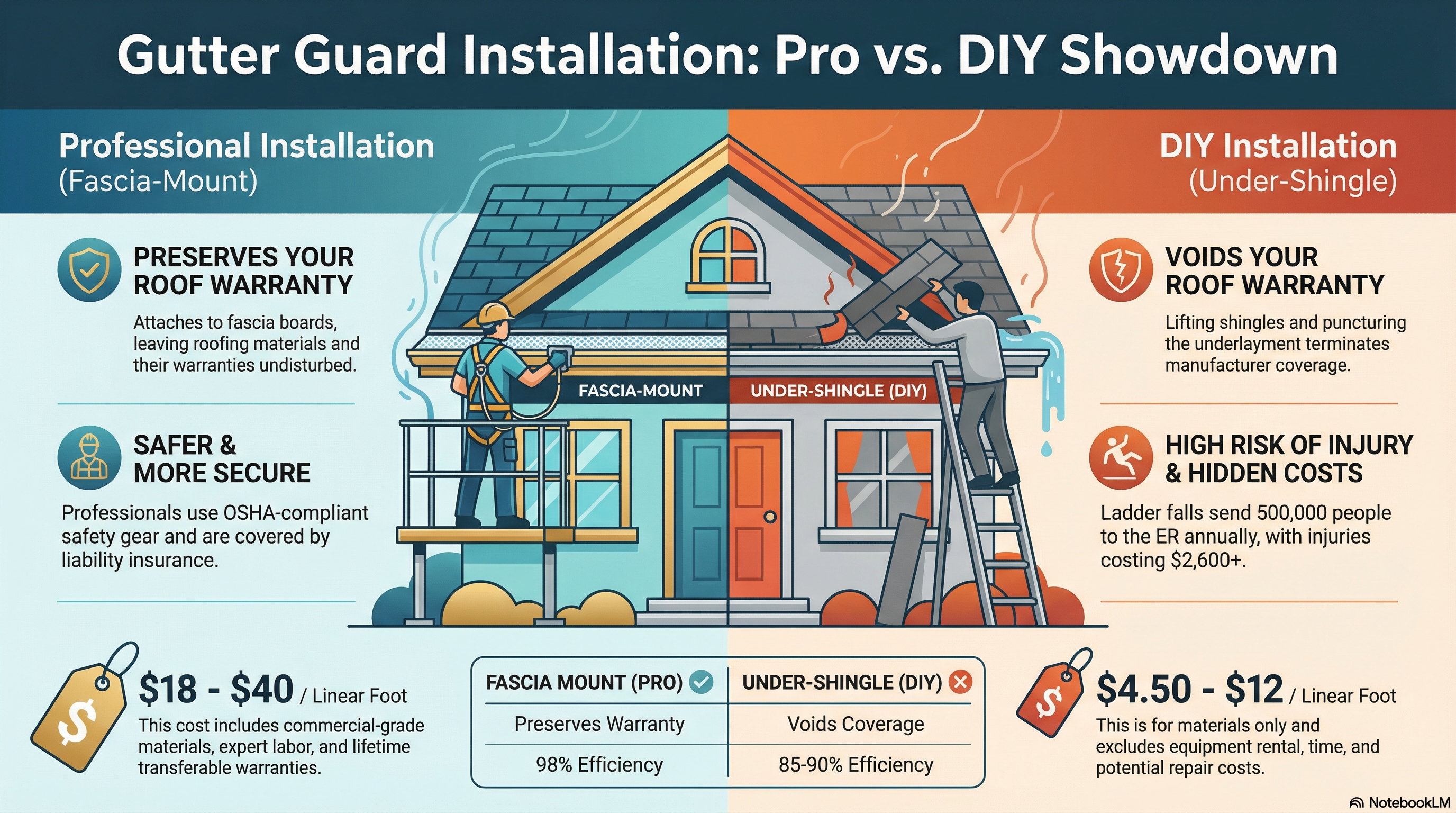
Professional gutter guard installers attach micro-mesh systems to fascia boards using stainless steel screws. This fascia-mount method preserves manufacturer warranties by avoiding roofing material disturbance. DIY under-shingle methods risk membrane punctures that void coverage.
Fascia-mount installation dominates professional practice. Mounting hardware secures to vertical fascia boards without requiring shingle lifting. Under-shingle methods create puncture points in roofing underlayment. National guard companies typically charge $18-$40 per linear foot for professional installation with lifetime warranties. Clean Pro Guard provides firm quotes at $22.50 per linear foot without requiring in-home sales consultations—homeowners receive transparent pricing based on satellite-measured linear footage within 15 minutes.
Under-shingle DIY installations force homeowners to lift roofing tabs, breaking factory-applied sealant bonds and creating entry points for wind-driven rain. Roofing manufacturers including CertainTeed, GAF, and Owens Corning void 20-30 year warranties after non-certified installers disturb shingle placement. Synthetic underlayment punctures during guard installation attempts terminate all manufacturer coverage.
Get Your Guard Installation Quote (15 Minutes) →Installation Method Comparison: Fascia Mount vs Under-Shingle
Clean Pro's installation methodology prioritizes fascia-mount systems to eliminate roof warranty risks while maintaining optimal water capture angles that align with existing gutter pitch requirements specified in IRC Code P2912.5.1.
| Installation Method | Roof Warranty Impact | Water Capture Efficiency | Removal for Maintenance |
|---|---|---|---|
| Fascia Mount (Professional) | Preserves Warranty — No shingle disturbance | 98% Efficiency — Maintains factory pitch | Reversible — 4 screws per 4-ft section |
| Under-Shingle (DIY) | Voids Coverage — Membrane punctures | 85-90% Efficiency — Alters drainage angle | Destructive — Breaks shingle tabs |
| Reverse Curve (Helmet Style) | High Risk — Requires shingle lifting | Variable — Surface tension dependent | Difficult — Entire gutter replacement needed |
Fascia-mount systems secure guards to vertical fascia boards using #8 x 3/4-inch stainless steel screws placed through pre-positioned pilot holes. Clean Pro Guard features pre-drilled mounting points spaced 12 inches apart, eliminating measurement errors that cause improper overlap or gaps between sections. Under-shingle methods slide guard edges beneath roofing tabs, forcing installers to lift shingles and insert mounting clips that penetrate synthetic underlayment—creating permanent puncture points that compromise waterproofing barriers.
Required Tools and Safety Equipment for Guard Installation
Professional guard installation demands commercial-grade equipment meeting OSHA safety standards to prevent ladder falls that send 500,000 people to emergency rooms annually, costing $2,600-$17,000 per injury for triage and fracture treatment.
Professional Installation Equipment Requirements
- Extension ladder system includes Type IA rating for 300-lb commercial capacity with stabilizer bars preventing fascia damage during repositioning
- Power tools require cordless drill with adjustable clutch limiting torque to 8-12 inch-pounds preventing fascia board splitting during screw insertion
- Measurement instruments verify existing gutter pitch using 24-inch levels detecting 1/8-inch-per-foot slope mandated by IRC P2912.5.1 for proper drainage
- Cutting equipment provides tin snips rated for 18-gauge aluminum making clean cuts through mesh material without fraying stainless steel weave
- Safety harnesses meet ANSI Z359.11-2014 standards with anchor points rated for 5,000-lb shock loads during fall arrest scenarios
DIY installations using big-box retail kits bypass professional equipment requirements, relying on household Type III ladders rated for only 200-lb capacity and lacking stabilizer bars that prevent lateral movement during transitions between sections. Homeowners attempting under-shingle installations without fall protection equipment violate OSHA standards that define "negligence" in premises liability lawsuits—Heiman v. Workers' Comp Appeals Board (2007) established precedent holding property owners liable for contractor injuries when directing unsafe work practices.
Step-by-Step Fascia-Mount Installation Process
Clean Pro's professional installation process maintains manufacturer specifications while preserving roof warranties through non-invasive fascia attachment methods that eliminate shingle disturbance.
Pre-Installation Gutter Preparation (Critical First Step)
Professional crews verify rain gutter systems meet structural requirements before guard installation begins. Sagging gutters require hanger reinforcement because guard weight adds 2-4 pounds per linear foot to existing system loads. Gutter systems pulling away from fascia boards need re-securing using hidden hanger brackets spaced 24 inches apart—standard spike-and-ferrule mounting fails under combined debris and guard weight exceeding 625 pounds for wet sludge loads in 50-foot sections.
Interior gutter cleaning precedes guard installation to establish baseline flow performance. Debris accumulation reduces effective gutter capacity from rated 4-6 inches per hour to under 1 inch per hour when organic matter blocks downspout openings. Clean Pro's pre-installation inspection includes verifying each downspout discharges freely to ground level—delays indicate underground drain clogs requiring powered auger clearing before guards prevent future access to interior channels.
Measurement and Section Planning
Accurate linear footage calculation determines material requirements and identifies transition points where guard sections require custom cutting to accommodate gutter end caps, downspout outlets, and corner miters. Professional installers measure roofline perimeter using laser distance tools accurate to ±1/8 inch over 100-foot spans. DIY measurements using retractable tape measures introduce ±3-5 inch errors that cause material shortages mid-project.
Guard section layout planning accounts for 1-2 inch overlap between adjacent 4-foot panels, ensuring seamless junctions that prevent debris infiltration through gaps. Clean Pro Guard features integral mesh underlap design creating weathertight seals at panel transitions without requiring silicone caulking that degrades in freeze-thaw cycles. DIY installations often leave 1/4-inch gaps between sections when homeowners fail to account for thermal expansion—aluminum frames expand 0.78 inches over 50-foot runs during 100°F temperature swings from winter to summer extremes.
Fascia Board Mounting Sequence
Stainless steel screw placement through pre-positioned pilot holes creates secure attachment points without splitting fascia board grain. Professional installers position screws 1 inch below gutter lip to ensure guards slope slightly downward toward front edge. This 2-3 degree angle prevents debris accumulation on mesh surface while maintaining water dam functionality that captures sheet flow from roof surfaces.
Screw depth control prevents over-tightening that crushes aluminum edge band material or under-tightening that allows wind uplift during storms. Cordless drills with adjustable clutch settings stop rotation at 8-12 inch-pounds of torque—sufficient to compress neoprene washers creating water-tight seals without deforming guard frame structure. Hand-tightening lacks torque consistency, resulting in loose fasteners that rattle during rain events or over-compressed joints that crack edge bands under thermal stress.
Pitch Alignment Verification
IRC Code P2912.5.1 mandates minimum 1/8-inch slope per linear foot (approximately 1% grade) directing water toward downspout outlets. Guard installation must not alter existing drainage angles—improper leveling creates standing water zones that exceed gutter load capacity calculations and cause premature hanger failure under wet sludge weight reaching 12.5 pounds per gallon (1.5x water density).
Professional installers use 24-inch levels checking pitch every 8 feet along guard length, adjusting shim placement beneath mounting screws to maintain consistent downward slope. Digital inclinometers measuring 0.5-degree increments verify compliance with building codes requiring 0.7-degree minimum angle for 5-inch K-style gutters. DIY installations frequently ignore pitch verification, installing guards perfectly level instead of maintaining manufacturer-specified drainage grade. Level installations reduce flow velocity to zero. Sediment deposition blocks micro-mesh apertures within 6-12 months.
Under-Shingle Installation Risks and Warranty Violations
Under-shingle guard mounting requires lifting roofing tabs to insert mounting clips beneath shingle edges. Mounting clips create penetration points through synthetic underlayment that void manufacturer warranties. Roofing manufacturers document these warranty exclusions in installation manuals specifying that "any alteration to shingle placement or underlayment integrity by non-certified installers terminates all coverage."
"Great service and friendly people. The perfect combo!"
— Randall Miller, Bardstown, KY
Shingle Tab Lifting Damage Mechanisms
Factory-applied sealant bonds secure shingle tabs to underlying courses, creating wind uplift resistance rated for 110-130 mph depending on product line. Lifting tabs to insert guard mounting hardware breaks these adhesive bonds permanently—sealant does not re-bond after disturbance, leaving lifted tabs vulnerable to wind peeling during storms. CertainTeed documents that "any shingle lifting voids the StreakFighter algae-resistance warranty and Integrity Roof System limited warranty."
Mounting clip insertion punctures synthetic underlayment at rates of 2-3 penetrations per linear foot of guard coverage. These puncture points create capillary pathways allowing wind-driven rain to bypass shingle weatherproofing and contact roof decking—OSB sheathing absorbs moisture at rates exceeding 15% by weight when exposed to liquid water, causing structural degradation and mold growth within wall cavities. Insurance adjusters cite under-shingle guard installation as evidence of homeowner negligence when denying water damage claims averaging $13,954 per incident.
When Under-Shingle Methods Apply (Rare Scenarios)
Steep-pitch roofs exceeding 8:12 slope (33.7 degrees) may require under-shingle installation when fascia boards sit at angles preventing secure screw placement. Historical homes with built-in gutter systems lacking external fascia boards necessitate under-shingle attachment as the only mounting option. Professional installers use specialty roof sealant rated for freeze-thaw cycling to seal each underlayment penetration, adding $3-6 per linear foot to installation costs.
Clean Pro Guard's under-shingle compatibility includes third water decelerator increasing flow control capacity to 60 gallons per minute during extreme rainfall events. The additional decelerator compensates for steeper mounting angles that increase water velocity across mesh surfaces—without this third control element, water overshoots guard edges during storms exceeding 3-4 inches per hour intensity.
DIY Installation: Cost Savings vs Hidden Expenses
Big-box retail guard kits cost $4.50-$12 per linear foot for materials including plastic mesh screens or aluminum micro-perforated panels with snap-in mounting clips. These DIY material costs exclude professional installation labor adding $14-28 per linear foot for expertise preventing warranty violations and ensuring proper pitch alignment.
| Cost Category | DIY Installation | Professional Installation |
|---|---|---|
| Materials (150 ft home) | $675-$1,800 — Retail kit pricing | $2,700-$6,000 — Commercial-grade systems |
| Equipment rental | $175-$370 — Ladder, drill, safety gear | $0 — Included in service |
| Time investment | 12-16 hours — Learning curve delays | 4-6 hours — Experienced crew |
| Warranty coverage | 1-2 years — Material defects only | Lifetime transferable — Labor and materials |
| Roof warranty risk | Full void — Under-shingle methods | Preserved — Fascia-mount compliance |
Hidden DIY costs include emergency room visits averaging $2,600 for ladder fall triage when homeowners attempt installations using inadequate Type III household ladders lacking stabilizer bars. Consumer Product Safety Commission data documents 164,000 annual ladder injuries requiring medical treatment, with 300 fatalities occurring during home maintenance tasks including gutter work. Homeowner's insurance policies exclude coverage for injuries sustained during "business pursuits"—DIY guard installation meets this exclusion definition when homeowners hire themselves as unpaid contractors.
Professional Installation Value Proposition
Certified installers carry $1 million general liability insurance covering property damage and bodily injury during guard installation work. This insurance protection transfers injury liability from homeowners to professional contractors—critical coverage preventing $17,000-$41,000 fracture treatment costs when falls occur during roofline work. Clean Pro vets all independent service providers in its network, requiring proof of active insurance coverage and safety training certifications before allowing contractor participation.
Professional installation includes a post-installation check verifying guards capture 98% of rainfall. This performance verification eliminates guesswork about whether DIY installations function properly—homeowners lack flow measurement equipment to confirm guards meet manufacturer specifications for water handling capacity. Lifetime transferable warranties increase home resale values by $2,800-$4,200 according to National Association of Realtors data on maintenance-free exterior features.
Specialized Installation Scenarios
Architectural complexity introduces installation challenges requiring professional expertise beyond standard fascia-mount procedures applicable to simple gable roof homes with uniform fascia heights.
Multi-Story Homes with Height Transitions
Two-story installations require Type IA extension ladders reaching 28-32 feet with stabilizer bars preventing lateral movement during section-to-section transitions. Fall protection harnesses meeting ANSI Z359.11-2014 standards become mandatory for work above 20 feet. Anchor points rated for 5,000-lb shock loads attach to roof structure, not gutter systems incapable of supporting fall arrest forces. Professional installers complete two-story guard coverage in 6-8 hours including multiple ladder repositioning cycles. DIY attempts average 20-24 hours due to unfamiliarity with high-altitude safety protocols.
Historic Homes with Built-In Box Gutters
Built-in gutter systems integrated into roof framing lack external fascia boards for guard mounting, requiring under-shingle installation as the only attachment method. Historic preservation codes in designated districts prohibit visible fasteners on period-correct architecture—installers must hide mounting hardware beneath roofing materials while maintaining waterproofing integrity. Specialty roof sealants rated for 50-year service life seal each underlayment penetration, adding $370-$890 per installation to standard pricing.
Copper Gutter Systems Requiring Material Compatibility
Galvanic corrosion occurs when dissimilar metals contact in presence of moisture—aluminum guards on copper gutters create 0.55-volt potential difference exceeding 0.25-volt threshold for electrochemical reactions. This battery effect dissolves aluminum frames within 18-36 months, requiring replacement. Professional installations on copper systems use stainless steel guards with nylon isolation washers preventing metal-to-metal contact that triggers corrosion. For detailed corrosion science, homeowners should review galvanic corrosion risks when mixing copper and aluminum materials.
Post-Installation Maintenance Requirements
Micro-mesh guards require annual surface cleaning to remove pollen cake, roof granule accumulation, and organic debris that blocks 990-micron apertures over time. Brush cleaning using soft-bristle deck brushes removes surface debris without damaging stainless steel weave—pressure washing exceeding 1,500 PSI bends mesh material, creating permanent deformation that reduces water flow efficiency.
Warranty terms require professional inspection every 2-3 years verifying guard attachment security and checking for fascia board degradation beneath mounting hardware. Installers re-torque mounting screws to factory specifications during inspections, preventing wind uplift damage during storms. Clean Pro's no-clog guarantee covers free professional cleaning when guards accumulate debris—this warranty protection applies only to professional installations meeting manufacturer specifications for proper pitch alignment and secure fastening.
Regional Gutter Guard Installation Coverage
Clean Pro's professional installation network connects homeowners with certified installers carrying $1 million liability insurance and OSHA-compliant safety equipment. Fascia-mount installation preserves roof warranties across diverse climate zones and architectural styles.
Northern Climate & Multi-Story Installation Specialists
Snow-load regions require guards rated for 1,200+ lb roof load capacity during ice accumulation events. Professional installers in Boston, New York, Philadelphia, Chicago, St Louis, and Denver use Type IA extension ladders and fall protection harnesses meeting ANSI Z359.11-2014 standards for two-story homes with steep-pitch roofs common in freeze-thaw climates.
High-Volume Rainfall & Storm Protection Zones
Southern markets experiencing 40-60 inches annual rainfall require guards with 98% water capture efficiency during 3-4 inch-per-hour storm intensities. Certified installation teams serve Houston, Atlanta, Charlotte, Nashville, Dallas, and Seattle, verifying proper pitch alignment preventing standing water zones that exceed gutter load capacity.
Request your 15-minute quote for CleanPRO Guard installation with lifetime transferable warranty coverage.
Related Gutter Protection Resources
Guard installation represents one component of comprehensive gutter protection strategy. Professional service providers in Clean Pro's network also connect homeowners with specialists for related drainage and roofing projects:
- Professional cleaning services cost $218-$470 annually for homes without guard systems, eliminating bi-annual ladder work and reducing fall injury risks (compare professional cleaning costs vs DIY equipment investment)
- Warranty compliance verification protects 20-30 year roofing investments when installers disturb shingle placement or puncture underlayment (understand the impact on roof warranty from improper guard installation methods)
- Mesh performance specifications detail 990-micron aperture sizing and 48.16% open area ratios preventing debris infiltration while maintaining 98% water flow efficiency (review technical specifications for surgical-grade stainless steel construction)
- Guard maintenance protocols outline annual cleaning requirements and warranty inspection schedules preserving lifetime coverage (learn proper cleaning techniques preventing mesh damage and warranty violations)
Professional fascia-mount installation costs $18-$40 per linear foot to preserve roof warranties while eliminating the 500,000 annual ladder injuries that result from DIY attempts.
Schedule Professional Installation (Satellite Quote in 15 Minutes) →