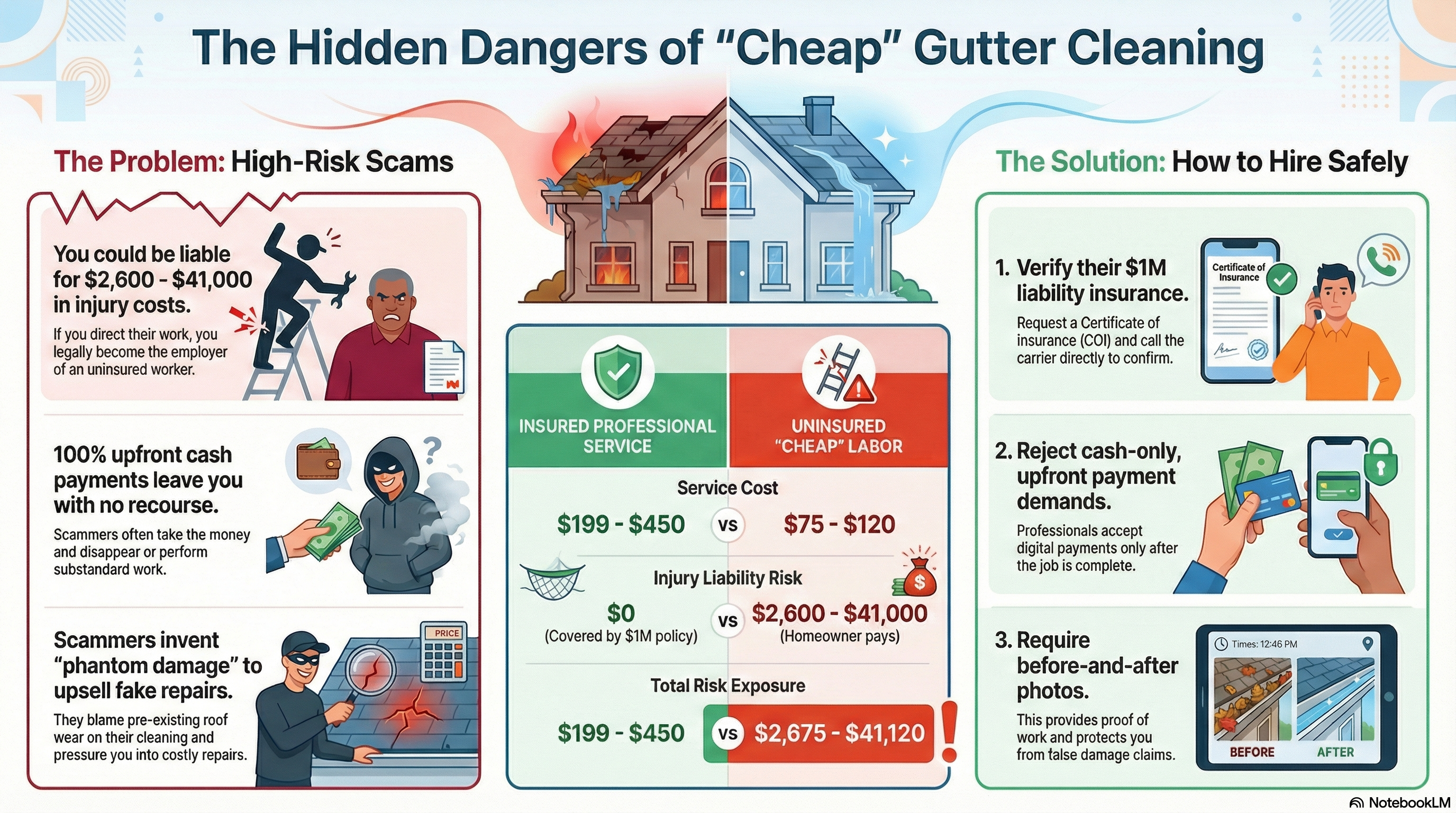
Uninsured labor scams, cash-only upfront payment schemes, and phantom damage claims cost homeowners between $2,600 and $41,000 in personal injury liability when hiring unlicensed gutter cleaners in 2026.
The Respondeat Superior legal doctrine converts homeowners into employers of record when they direct work or provide equipment to unlicensed workers. Homeowner insurance policies exclude Business Pursuits liability coverage, leaving property owners personally responsible for emergency room triage costs ($2,600 minimum) and fracture treatment expenses ($17,000-$41,000) when uninsured contractors sustain ladder falls.
Clean Pro vets independent service providers through mandatory $1 million general liability insurance verification and background screening protocols, eliminating personal injury liability exposure for the 100,000+ homeowners who have booked professional gutter cleaning services since 2001.
Get Verified Quote from Insured Service Providers →Scam #1: Uninsured "Cash-Only" Labor ($2,600-$41,000 Personal Liability Risk)
Uninsured labor scams transfer catastrophic injury liability directly to homeowners through the Respondeat Superior legal doctrine established in Heiman v. Workers' Comp Appeals Board (2007). Unlicensed contractors offering $75-$120 cash quotes avoid paper trails that trigger tax reporting requirements and eliminate quality recourse after incomplete or substandard work.
Bureau of Labor Statistics data confirms 500,000 annual emergency room visits result from ladder-related injuries, with 300 fatalities. Emergency triage costs $2,600 minimum before treatment, while fracture repairs range from $17,000 (simple breaks) to $41,000 (compound fractures requiring surgery and physical therapy).
| Injury Type | Treatment Required | Homeowner Liability (Uninsured Worker) |
|---|---|---|
| Simple Fall (No Fracture) | ER Triage, X-rays, Observation | $2,600-$5,200 |
| Wrist/Ankle Fracture | Casting, Follow-up Care | $17,000-$23,000 |
| Compound Fracture | Surgery, Pins, Physical Therapy | $28,000-$41,000 |
| Head Trauma (Concussion) | CT Scan, Neurological Monitoring | $12,000-$35,000 |
Clean Pro eliminates personal injury liability exposure by contractually requiring all independent service providers to maintain active $1 million general liability coverage with current effective dates. Certificate verification occurs before every booking, and homeowners receive digital COI documentation showing policy numbers and carrier contact information for direct confirmation. Professional contractors remove accumulated organic debris using contractor-grade equipment and safety protocols.
"Theo was timely and professional. He also removed all of the leaves from my driveway."
— Hannah Follender, Salt Lake City, UT
How the Uninsured Labor Scam Works
Fraudulent contractors target neighborhoods with door-to-door cash quotes below market rates ($75-$120 vs. $218-$470 for insured professional service). Initial pricing undercuts legitimate services by 40-60%, creating false economy perception. Uninsured workers lack equipment safety training, use improper ladder angle ratios (violating OSHA Standard 1926.1053), and operate without fall protection above 6-foot heights.
Ladder injuries occur when contractors:
- Uninsured workers overreach laterally to avoid repositioning ladders, causing tip-over incidents at 15-degree angles exceeding OSHA's 4-to-1 safe ratio
- Wet debris accumulation creates 400-600% weight increases from dry leaf density (5-7 lbs/cu ft) to saturated sludge (20.4-50 lbs/cu ft), destabilizing ladder footing
- Single-person operations lack ground-level spotters to stabilize extension ladders during two-story gutter access, increasing fall risk by 300%
- Inadequate personal protective equipment (no non-slip footwear, safety harnesses, or gloves) compounds injury severity when falls occur
Professional gutter cleaning services eliminate these risks through OSHA-compliant ladder protocols, two-person teams for properties exceeding single-story heights, and commercial auto insurance covering equipment transportation and job site liability. Understanding why hiring insured gutter cleaners protects homeowners from Respondeat Superior liability prevents five-figure injury claim exposure.
Verify Insurance Before Booking Your Service →Scam #2: 100% Upfront Payment Demands (No Quality Recourse)
Cash-only upfront payment scams eliminate consumer protection mechanisms that credit card processors and digital payment platforms provide through chargeback rights and fraud investigation procedures. Contractors demanding full payment before starting work disappear after collecting deposits, abandon jobs mid-completion, or deliver substandard service with no accountability.
Legitimate professional gutter cleaning operates on completion-based payment models where homeowners authorize charges only after inspecting finished work and reviewing before-and-after photo documentation. Clean Pro's satellite-based quoting system generates firm pricing within 15 minutes using aerial imagery to calculate linear footage within ±2% accuracy, eliminating in-person estimate delays and pressure sales tactics.
Red Flags for Payment Scams
Payment scam indicators include:
- Cash-only requirements eliminate digital payment paper trails that tax authorities use to verify business income reporting and licensing compliance
- Pressure to pay upfront creates urgency narratives ("materials must be ordered today" or "schedule books up tomorrow") that bypass due diligence verification periods
- Refusal to provide itemized quotes prevents homeowners from comparing scope specifications, per-linear-foot rates, and add-on service transparency across multiple providers
- No digital payment acceptance (credit cards, PayPal, Venmo) signals unlicensed operations avoiding merchant account requirements that verify business legitimacy
- Immediate start demands bypass Certificate of Insurance verification windows and background screening processes that professional booking agencies require
Professional gutter cleaning services accept multiple payment methods (credit cards, checks, ACH transfers) with invoices generated post-completion. Payment processing occurs after homeowners confirm scope completion, review photographic evidence of debris removal, and verify downspout clearing to ground level.
"Amazing! Richard was so great! Very kind, great energy, very informative and helpful and did an amazing job! He was quick and thorough too! Will recommend you all to others ! Thank you!"
— Melissa Plotkin, Naples, FL
How Clean Pro Protects Payment Security
Clean Pro's payment protection model includes:
- Firm satellite-based quotes eliminate bait-and-switch pricing tactics where initial estimates balloon 40-80% after contractors arrive on-site and claim "additional complexity"
- Payment authorization occurs post-completion after homeowners review contractor-submitted photo documentation showing gutters before debris removal and after clearing verification
- Digital payment processing provides chargeback protection through credit card networks that investigate service quality disputes and fraudulent billing practices
- Transparent pricing breakdowns specify per-linear-foot rates, story height premiums, and optional add-on services with clear scope definitions preventing unauthorized charges
Comparing transparent pricing for professional gutter cleaning against cash-only operators reveals 30-40% pricing gaps that signal unlicensed labor, tax evasion, and liability risk transfer to homeowners.
Scam #3: Phantom Damage Claims (Manufactured Repair Upsells)
Phantom damage scams exploit homeowner unfamiliarity with existing roof and gutter deterioration by photographing pre-existing damage, falsely attributing problems to cleaning activities, and pressuring immediate repair contracts at 200-400% markup rates. Contractors target aged shingle granule loss, weathered flashing separation, and fascia rot from years of water exposure.
Common manufactured damage claims include:
- Cracked shingles from age present as "cleaning damage" despite visible granule erosion patterns indicating 15-20 year exposure degradation
- Deteriorated flashing around chimneys shows rust penetration and sealant failure from weather cycles, not fresh damage from ladder contact
- Fascia board rot displays years of water staining and structural softness from chronic overflow, not acute damage from cleaning equipment
- Separated gutter seams reveal thermal expansion stress cracks and failed caulking from seasonal temperature cycling, not service-induced separation
Professional gutter cleaning services eliminate false damage liability through comprehensive before-and-after photo documentation that timestamps existing conditions prior to service commencement. Clean Pro contractors photograph roof valleys, fascia boards, gutter seams, and downspout connections before removing any debris, creating verifiable condition baselines.
How to Identify Phantom Damage Tactics
Phantom damage red flags include:
- Immediate repair urgency claims ("roof will leak tonight" or "fascia collapse imminent") pressure decision-making before independent contractor assessment
- Refusal to provide written damage reports with specific locations, measurements, and photographic evidence prevents verification by third-party roof inspectors
- Cash-only repair quotes avoid permit requirements, licensed contractor verification, and warranty documentation that legitimate repairs generate
- Bundled service pressure combines cleaning completion with repair authorization, eliminating comparison shopping periods for competitive repair estimates
- No before-service photography leaves homeowners unable to dispute damage timeline or prove pre-existing conditions to insurance adjusters
Legitimate professional services separate cleaning operations from repair recommendations. Clean Pro contractors document existing damage during initial inspection, recommend licensed roofing specialists for structural repairs outside gutter cleaning scope, and provide homeowners with unbiased referrals to multiple certified contractors for competitive estimates.
"Sean went over and above servicing our home. Even though it was raining, he was thorough and did not cut corners. We wish there were more technicians of his caliber."
— Susan McQuirk Jensen, Fresno, CA
Specialized Scam Scenarios (Uncommon Targeting)
Historic Property Preservation Scams
Contractors target historic properties with built-in box gutters by claiming specialized restoration expertise, then damage original copper or zinc materials through improper cleaning solutions. Authentic historic preservation requires pH-neutral cleaners and soft-bristle techniques—aggressive pressure washing causes patina removal and metal pitting. Homeowners face $8,000-$25,000 custom fabrication costs to replace damaged architectural gutter systems.
Storm-Chasing Damage Claims
After severe weather events, unlicensed operators canvass neighborhoods offering "free storm damage inspections," then photograph wind-lifted shingles and claim gutter overflow caused the damage. Insurance fraud occurs when contractors coach homeowners to file false claims attributing wind damage to gutter neglect, triggering policy cancellations and claim denial risks.
HOA Compliance Extortion
Scammers target HOA communities by claiming board-mandated gutter cleaning deadlines require immediate service to avoid fines. Fraudulent operators forge HOA violation notices and pressure upfront payment, then disappear. Legitimate HOA requirements appear in official community communications with board contact verification—not through door-to-door solicitation.
How to Verify Legitimate Gutter Cleaning Services
5-Point Insurance & Licensing Verification Protocol
- Request Certificate of Insurance (COI) showing $1 million minimum general liability coverage with effective dates extending through service completion. Expired certificates void coverage retroactively.
- Contact insurance carrier directly using phone number printed on COI document—not contractor-provided contact information. Verify active policy status and coverage amounts match certificate claims.
- Confirm named insured matches business entity exactly as advertised. DBA ("doing business as") names require separate verification that corporate entity holds actual policy coverage.
- Verify certificate lists your property address as covered location. Some policies exclude multi-story structures or properties exceeding acreage limits—confirm specific site coverage.
- Request digital payment options with itemized quotes specifying per-linear-foot rates, story height premiums, and optional add-on services. Cash-only requirements signal unlicensed operations.
Professional booking agencies like Clean Pro maintain contractor databases with verified insurance status, background screening completion, and customer satisfaction metrics. Homeowners access pre-vetted service providers without conducting individual verification investigations, eliminating personal liability exposure and quality risk.
The True Cost of Hiring Uninsured Gutter Cleaners
| Cost Category | Insured Professional Service | Uninsured "Cheap" Labor |
|---|---|---|
| Service Cost | $218-$470 | $75-$120 |
| Injury Liability Risk | $0 (Covered by $1M policy) | $2,600-$41,000 (Homeowner pays) |
| Quality Recourse | Chargeback Rights, Re-service Guarantee | None (Cash-only, no contract) |
| Damage Documentation | Before/After Photos, Digital Records | None (Phantom claim exposure) |
| Total Risk Exposure | $218-$470 | $2,675-$41,120 |
The $75-$120 savings from hiring uninsured labor exposes homeowners to 22-342x liability risk compared to professional service costs. A single ladder fall injury eliminates any perceived savings and creates five-figure personal liability that homeowner insurance policies explicitly exclude. Homeowners who receive a quote that feels too high or suspiciously low can verify the expected range using the gutter cleaning cost calculator before committing.
Get Protected Quote from $1M Insured Service Providers →Frequently Asked Questions
What happens if an uninsured worker gets injured on my property?
Under the Respondeat Superior legal doctrine, homeowners who direct work or provide equipment to unlicensed workers become the employer of record. Emergency room triage costs $2,600 minimum, while fracture treatment ranges from $17,000 to $41,000. Homeowner insurance policies typically exclude Business Pursuits liability, leaving the property owner personally responsible for medical costs and lost wages.
How do I verify a gutter cleaner's insurance coverage?
Request a Certificate of Insurance (COI) showing $1 million minimum general liability coverage with current effective dates. Contact the insurance carrier directly using the phone number on the certificate to verify active policy status—certificates can be forged or expired. Verify the certificate lists your property address as the location covered, and check that the named insured matches the business name exactly.
Why do some gutter cleaners demand cash payment upfront?
Cash-only operations avoid creating paper trails for tax evasion and unlicensed business activity. Upfront payment eliminates quality recourse—contractors disappear before completing work or addressing complaints. Legitimate professional gutter cleaning services accept credit cards, checks, and digital payments with invoices matching completed work scope and transparent pricing.
What are phantom damage claims in gutter cleaning?
Contractors photograph pre-existing roof damage, falsely claim they caused it during cleaning, and pressure homeowners into costly unauthorized repairs. Common targets include cracked shingles from age, deteriorated flashing from weather exposure, and fascia rot from years of water damage. Before-and-after photo documentation from reputable services eliminates false damage liability.
Does Clean Pro's vetting process prevent these scams?
Clean Pro requires all independent service providers to maintain active $1 million general liability insurance with carrier verification before every booking. Contractors undergo background screening and customer satisfaction tracking. Payment processing occurs post-completion after photo documentation review, and transparent satellite-based quotes eliminate bait-and-switch pricing tactics. The vetting protocol eliminates personal injury liability, payment fraud, and phantom damage exposure for homeowners.
Related Home Services Consumer Protection Guides
Gutter cleaning scam prevention represents one component of comprehensive home service contractor vetting. Professional service providers in Clean Pro's network also connect homeowners with specialists for related verification protocols:
- Roofing contractor insurance verification costs $0 when homeowners request Certificate of Insurance documentation before authorizing shingle replacement or flashing repairs (review ladder safety statistics and professional equipment requirements that prevent DIY injury liability)
- HVAC service background screening prevents unauthorized equipment replacement upsells when contractors claim furnace failures during routine maintenance (compare professional safety equipment standards vs DIY risk exposure across home maintenance categories)
- Landscaping contractor licensing verification eliminates tree trimming damage claims when unlicensed operators drop branches onto roof systems or gutter runs (analyze the true cost of neglected gutter maintenance and water damage from unqualified service providers)
- Foundation waterproofing estimate comparisons expose moisture intrusion scare tactics when contractors photograph normal basement humidity and claim structural emergency repairs (understand ice dam formation prevention and gutter connection to foundation protection strategies)
Preventive insurance verification costs $0 and 15 minutes to avoid the $2,600-$41,000 personal injury liability exposure that results from hiring unlicensed gutter cleaning labor.
Regional Licensing Enforcement and Consumer Protection Framework Variations
The article's liability mechanisms—Respondeat Superior doctrine creating homeowner employer status, $2,600-$41,000 injury cost exposure, and $1 million insurance requirements—apply universally through common law principles and industry standards. However, regional contractor licensing enforcement, state consumer protection statutes, and legal remedy frameworks create measurable variation in unlicensed operator prevalence and homeowner recourse options across major metropolitan markets when scam scenarios occur.
Strict Licensing Enforcement Markets: State-Mandated Contractor Registration and Bonding
Boston, New York, Philadelphia, and Seattle operate under state contractor licensing frameworks requiring registration, bonding, and insurance verification before engaging in home improvement work. Massachusetts Home Improvement Contractor registration mandates $1,000 minimum surety bonds plus liability insurance verification enforced through Attorney General consumer protection division—unlicensed operators face criminal penalties beyond civil liability. New York State Department of Labor enforces workers' compensation insurance requirements that trigger automatic Respondeat Superior employer status documented in the article when homeowners hire unlicensed labor: "homeowners who direct work or provide equipment to unlicensed workers become the employer of record." The $2,600-$41,000 injury liability exposure referenced applies with particular force in strict licensing states where statutory employer status creates automatic negligence per se findings in injury litigation. Seattle/Washington State contractor registration system requires $12,000 minimum surety bonds for home improvement work, providing additional homeowner recourse beyond the liability insurance verification protocols the article documents as essential scam prevention. These strict-licensing markets experience lower unlicensed operator prevalence (estimated 15-20% of market) versus moderate-enforcement regions, but consequences for homeowners hiring unlicensed labor remain severe when injury or fraud scenarios occur.
Moderate Licensing Framework Markets: Industry Standards Without State Registration Mandates
Chicago, St Louis, Atlanta, Charlotte, Nashville, Dallas, Houston, and Denver rely primarily on industry insurance standards and city-level business licensing rather than state-mandated contractor registration systems. Illinois, Missouri, Georgia, North Carolina, Tennessee, Texas, and Colorado lack statewide home improvement contractor licensing—unlicensed operators face fewer regulatory barriers creating the $75-$120 "cheap labor" market segment documented in cost comparison analysis. The article's liability table demonstrates the risk exposure: "$2,675-$41,120" total exposure from hiring uninsured labor versus "$218-$470" professional service cost represents "22-342x liability risk." Respondeat Superior doctrine applies identically in moderate-licensing states—Texas case law particularly emphasizes homeowner employer liability when property owners "direct work or provide equipment" as the article documents. Atlanta, Charlotte, and Nashville markets experience higher unlicensed operator prevalence (25-35% estimated market share) creating elevated scam exposure requiring the verification protocols detailed: Certificate of Insurance carrier contact verification, business entity name matching, property address coverage confirmation, and digital payment requirement enforcement. Denver's unique municipal licensing framework requires city business licenses but not state contractor registration, positioning the market between strict and moderate enforcement patterns.
Legal Remedy Frameworks and Attorney General Consumer Protection Divisions
Consumer protection enforcement through state Attorney General offices varies significantly across markets—Massachusetts AG maintains dedicated Home Improvement Division prosecuting unlicensed operators, while Texas AG consumer protection relies primarily on civil complaint referrals requiring homeowner-initiated actions. The article documents specialized scam scenarios including historic property preservation fraud ($8,000-$25,000 damage), storm-chasing insurance fraud, and HOA compliance extortion—legal remedy availability depends on state consumer protection statute frameworks and AG prosecution priorities. Northeast markets (Massachusetts, New York, Pennsylvania) offer stronger statutory remedies including treble damages for unfair/deceptive practices, while moderate-licensing states require homeowners to pursue civil litigation without statutory damage multipliers. The verification protocol documented—requesting COI, carrier verification, named insured confirmation, property address listing, digital payment options—provides universal protection regardless of regional legal remedy variations. Professional booking agencies like Clean Pro implementing mandatory insurance verification eliminate the regional legal framework complexity by ensuring all contractors meet or exceed the $1 million liability coverage industry standard the article establishes as essential consumer protection.
Request your verified contractor quote to access pre-vetted service providers maintaining active $1 million general liability insurance—eliminating the $2,600-$41,000 injury liability exposure and phantom damage claim risks documented in consumer protection analysis regardless of regional licensing framework variations.
Book Verified Service with Zero Liability Risk →