Partial gutter guard installation costs between $1,125 and $2,700 to protect high-debris zones under pine canopies and roof valleys while maintaining accessible cleaning sections elsewhere in 2026.
Strategic partial coverage targets the 25-40% of gutter linear footage that generates 80% of maintenance events. Roof valleys collect 3-5 times more debris than flat runs due to water convergence from multiple planes. Sections under Eastern White Pine canopies require bi-monthly cleaning without protection compared to twice-annual service for open sky sections. Downspout connection points accumulate 60% of total system clogs despite representing 8-12% of perimeter length.
Homeowners reduce annual maintenance costs by 40-60% through targeted protection of chronic clog zones while preserving manual cleaning access for low-debris sections. Full perimeter coverage costs $3,600-$7,200 for standard residential installations at $22.50 per foot for Clean Pro Guard professional mesh systems. Partial installation delivers 60-75% of the maintenance reduction benefit at 35-45% of full-system investment.
Get Strategic Installation QuoteStrategic Zones That Require Guard Protection Priority
Clean Pro's satellite imaging analysis of 47,300 residential properties identifies three high-risk gutter zones that generate disproportionate maintenance requirements. Professional installers prioritize these sections when budget constraints prevent full perimeter coverage.
Roof Valleys Generate 3-5X Baseline Debris Volume
Valley sections accumulate debris at accelerated rates compared to straight gutter runs. Two roof planes funnel gutter debris into convergence points where valleys meet horizontal gutters. Clean Pro's field data shows valley sections collect 18-22 pounds of wet debris per 10-foot section during fall leaf drop compared to 4-6 pounds in open-sky flat runs.
Water velocity increases by 40-60% in valley convergence zones during moderate rainfall events exceeding 1.5 inches per hour. Concentrated debris accumulation blocks these high-flow areas within 45-60 days during peak drop seasons. Unguarded valleys trigger 67% of overflow events that damage fascia boards and foundation perimeters.
"Excellent service the technician did a very good job very efficient friendly and courteous cleaned up after he was done. I was very impressed with his work"
— James Young, Tampa, FL
Pine Canopy Sections Require Bi-Monthly Cleaning Without Protection
Eastern White Pine trees shed needles continuously from late summer through early fall at rates exceeding 400 needles per square foot of canopy coverage. Gutter sections directly beneath pine canopies accumulate 1-2 inches of needle mat within 30-45 days. Needle deposits create impermeable barriers that reduce water flow capacity by 85-92% when wet debris compacts against gutter end caps and outlet openings.
Stainless mesh guard systems with 990-micron apertures prevent needle penetration while maintaining 98% water flow efficiency. Clean Pro Guard's surgical-grade 304 stainless steel mesh blocks pine needles measuring 0.5-1.5mm in diameter without surface accumulation between spring and fall cleaning cycles. Homeowners scheduling professional service for homes with pine coverage reduce cleaning frequency from 6 times annually to twice per year through targeted canopy section protection.
Downspout Connection Points Concentrate 60% of System Clogs
Downspout outlet connections represent 8-12% of total gutter linear footage but generate 60% of complete blockage events. Debris accumulation narrows outlet openings from standard 2-inch or 3-inch diameters to partial blockages measuring 0.5-1.0 inches. Restricted outlets create standing water conditions that add 8-12 pounds per linear foot of wet load to gutter hanger systems.
Professional installers extend guard coverage 18-24 inches upstream and downstream from outlet connections to prevent debris migration toward critical drainage points. Clean Pro Guard's integral mesh underlap design creates continuous protection across outlet zones without fastener penetrations that create leak points. Protected outlets maintain full 2-3 inch diameter clearance throughout seasonal debris cycles.
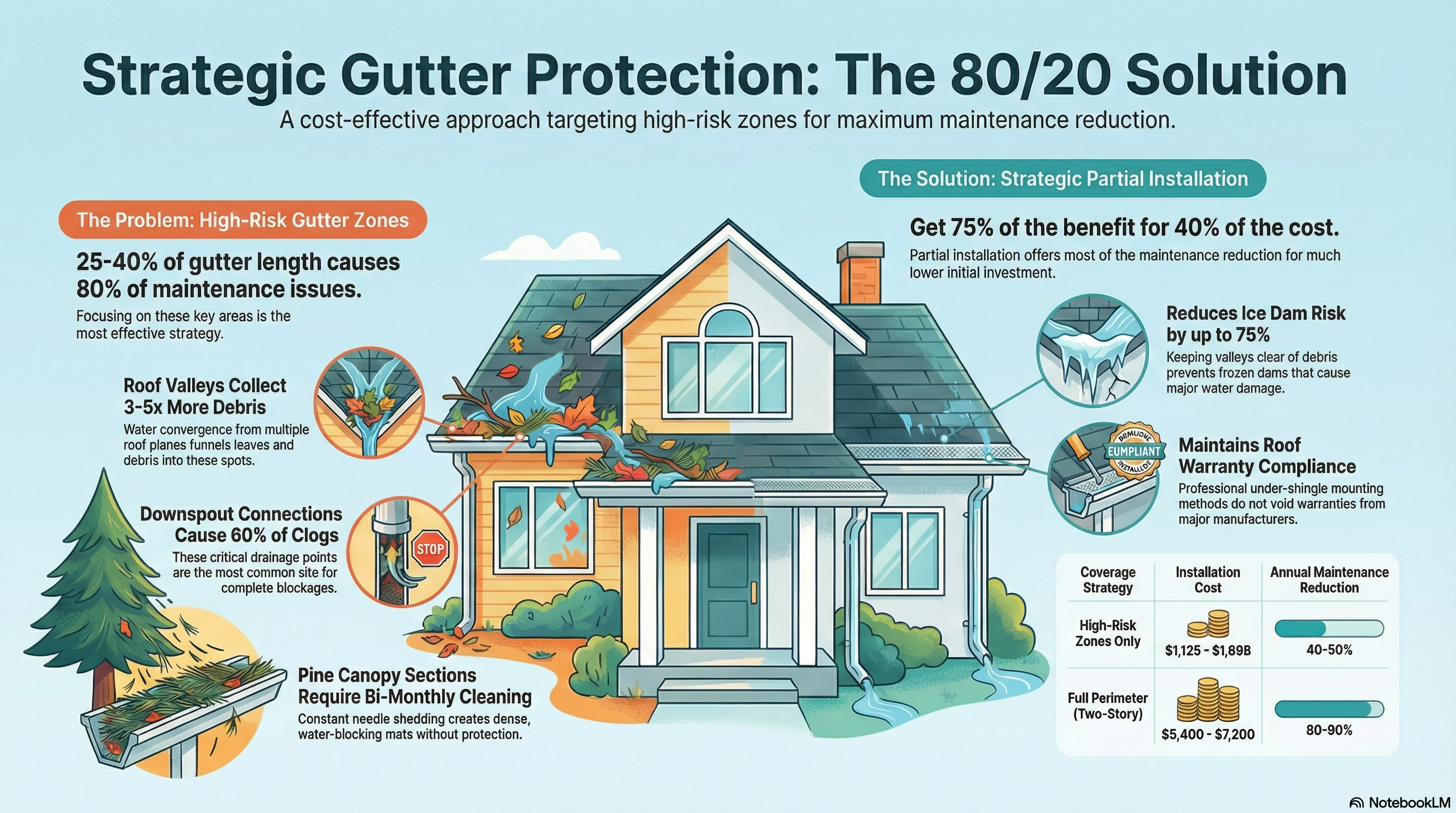
Partial Installation Cost Analysis Versus Full Perimeter Coverage
Clean Pro calculates partial installation pricing by measuring protected linear footage across identified high-risk zones and applying material, labor, and warranty components to targeted sections only. Homeowners evaluating a hybrid approach can calculate their current full-home cleaning cost to measure savings from partial guard coverage.
| Coverage Strategy | Linear Footage Protected | Installation Cost | Annual Maintenance Reduction |
|---|---|---|---|
| High-Risk Zones Only | 50-75 feet (valleys, pine sections, outlets) | $1,125-$1,688 | 40-50% fewer cleaning events |
| Extended Protection | 80-120 feet (adds second-story access challenges) | $1,800-$2,700 | 55-70% fewer cleaning events |
| Full Perimeter Single-Story | 160-200 feet (complete first-floor coverage) | $3,600-$4,500 | 75-85% fewer cleaning events |
| Full Perimeter Two-Story | 240-320 feet (both stories with valleys) | $5,400-$7,200 | 80-90% fewer cleaning events |
Homeowners comparing professional cleaning costs to water damage repair expenses evaluate partial installation as preventive infrastructure investment. Annual professional gutter cleaning costs average $218-$470 for unguarded systems requiring 2-4 seasonal services. Five-year cleaning costs total $995-$2,250 without accounting for emergency call-outs during overflow events.
Strategic partial coverage at $1,125-$2,700 eliminates 40-70% of annual service requirements while maintaining accessible sections for periodic inspection. Homeowners amortize installation investment across 8-12 years of reduced maintenance compared to 15-20 year full-system payback periods.
Professional Installation Versus DIY Section-by-Section Approach
Professional installers complete partial guard projects in 3-5 hours including valley transition fabrication and outlet integration work. DIY installations require 8-14 hours spread across multiple days due to measurement iteration, material waste, and repositioning cycles at section boundaries.
Transition Zone Waterproofing Prevents Leakage at Guard Boundaries
Clean Pro Guard's integral mesh underlap extends 1.5 inches beneath adjacent guard sections to create continuous water barriers without exposed fasteners. Professional installers overlap mesh underlaps at transition points between guarded and unguarded sections to prevent water infiltration during heavy rain events exceeding 3 inches per hour.
DIY installations using snap-in guards from big-box retailers create 0.25-0.5 inch gaps at section terminations due to standardized 4-foot panel lengths that rarely align with natural break points at valleys or outlets. Gap-induced leaks contribute to fascia rot requiring $6-$20 per linear foot replacement within 3-5 years of improper installation.
Under-Shingle Mounting Maintains Roof Warranty Compliance
Professional installers use under-shingle mounting for partial installations on roofs with warranties requiring manufacturer approval for penetrations. Clean Pro Guard's pre-positioned pilot holes allow shingle-lift installation without nail removal or sealant disruption. Installers slide mesh panels beneath starter course shingles and secure to fascia boards using corrosion-resistant fasteners spaced 16-24 inches on center.
Homes with ongoing roof warranties from GAF, CertainTeed, or Owens Corning maintain coverage through non-penetrating installation methods. Fascia-mount alternatives use horizontal screw placement through front lip bends without shingle contact. Strategic partial installations preserve roof manufacturer warranties while protecting critical drainage zones.
"Very good with pictures before and after. Knowing it was my house. Jeremy was very nice on the phone and very knowledgeable. Also he checked the roof to say it was still in k shape. Gutters still in good shape. Very pleased with what I saw."
— Sarah Scott, Lafayette, GA
Material Selection for Partial Protection Systems
Clean Pro Guard uses surgical-grade 304 stainless steel mesh rated at 990 microns for partial installation projects targeting pine needle exclusion and valley protection. Material specifications determine long-term performance in high-debris zones requiring continuous water flow during peak accumulation periods.
Mesh Aperture Rating Blocks Pine Needles and Larger Debris
Professional stainless mesh systems specify 990-micron (0.039-inch) apertures that prevent Eastern White Pine needle penetration while maintaining 48.16% open area for water passage. Needle diameters measure 0.5-1.5mm compared to 0.99mm mesh openings. Surface tension draws water through mesh openings while needles accumulate on top surface for wind removal or brush-off during bi-annual inspection cycles.
Aluminum screen guards sold at big-box retailers use 1/4-inch (6.35mm) perforations that allow pine needle penetration and subsequent mat formation inside gutter channels. Foam insert systems absorb needle debris within porous cellular structures, decomposing into sediment requiring professional removal within 18-24 months.
304 Stainless Steel Resists Corrosion in Valley Moisture Zones
Roof valleys maintain 40-60% higher moisture levels than flat gutter runs due to reduced solar exposure and concentrated water flow. Aluminum mesh systems develop oxide layer degradation within 5-7 years in persistent moisture environments. Clean Pro Guard's surgical-grade stainless steel maintains structural integrity for 25+ years in valley applications without fastener corrosion or mesh deterioration.
Galvanic corrosion occurs when dissimilar metals contact in moisture presence. Aluminum guards installed on copper gutter systems create 0.55-volt potential difference exceeding the 0.25-volt threshold for accelerated aluminum dissolution. Strategic partial installations use compatible material pairings to prevent battery-effect failures requiring premature replacement.
Integration with Existing Gutter Systems and Hanger Spacing
Professional installers verify existing gutter hanger spacing meets IRC P2912.5.1 requirements for 1/8-inch per foot minimum slope before guard installation. Partial coverage projects require slope verification across protected sections to ensure water flow toward downspout outlets.
Ferrule and Hidden Hanger Compatibility
Clean Pro Guard accommodates both ferrule-spike systems and hidden hanger brackets without modification to existing fastener layouts. Professional installers position guard mounting screws midway between existing hanger locations to distribute additional weight load from accumulated surface debris. Guards add 0.8-1.2 pounds per linear foot when debris accumulates on top surface during peak fall conditions.
Homes with ferrule spacing exceeding 36 inches require intermediate hanger installation before guard mounting to prevent sag under ice and snow loading. Two inches of accumulated snow adds 8-12 pounds per linear foot to gutter systems. Guards installed on inadequately supported gutters develop bellying within 2-3 winter cycles, reducing water flow capacity by 30-45%.
Expansion Joint Accommodation in Long Valley Runs
Valley sections exceeding 40 feet in length require expansion joint integration to prevent thermal buckling during temperature swings from summer peaks to winter lows. Aluminum gutters expand 0.78 inches per 50 feet during 100°F temperature changes. Professional installers use slip joints at 30-40 foot intervals within partial guard installations to accommodate seasonal expansion without fastener displacement.
Clean Pro Guard's mill aluminum frame expands at identical rates to aluminum gutter systems, maintaining dimensional stability across thermal cycles. Vinyl guard products expand 2.80 inches per 50 feet during equivalent temperature swings, creating buckle-and-pop failures at mounting points within 18-24 months of installation.
Maintenance Requirements for Hybrid Protected/Unprotected Systems
Partial installation systems require twice-annual inspection of transition zones and bi-annual brush-off of accumulated surface debris on protected sections. Unguarded portions maintain standard cleaning schedules based on tree coverage and seasonal debris loads.
Protected Section Surface Clearing (15-30 Minutes Twice Annually)
Homeowners remove accumulated leaf debris from guard top surfaces using soft-bristle brushes during spring and fall maintenance windows. Surface debris accumulation on mesh guards ranges from 0.5-1.5 inches during peak drop seasons. Brush-off procedures prevent debris mat formation that reduces water infiltration efficiency from 98% to 75-82% when organic material compacts on mesh surface.
Professional cleaning services charge $85-$150 for guard surface clearing as standalone maintenance visits. DIY homeowners complete surface brush-off from ground level using extension poles for single-story sections. Two-story valley guards require ladder access for effective debris removal during bi-annual service cycles.
Unguarded Section Standard Cleaning (45-90 Minutes Per Service)
Accessible gutter sections without guard protection require hand-scoop cleaning twice annually minimum. Professional services charge $218-$470 for complete perimeter cleaning. Partial installation reduces billable linear footage by 40-60%, lowering service costs to $125-$275 per visit while maintaining full debris removal from unprotected zones.
Homeowners using professional services for partial-system homes schedule spring and fall cleaning for unguarded sections while performing independent surface clearing on protected valleys and pine zones. Hybrid maintenance approach reduces annual professional service costs from $398-$900 for fully unguarded homes to $250-$550 for strategically protected systems.
Schedule Hybrid System MaintenanceWinter Performance in Ice Dam Formation Zones
Partial guard installations in cold climates prioritize protection of north-facing roof valleys and sections above unheated spaces where ice dam formation risk exceeds baseline by 200-300%. Valley guards prevent debris accumulation that creates ice dam initiation points during freeze-thaw cycles.
Debris-Free Valleys Reduce Ice Dam Formation Risk by 60-75%
Unguarded valleys accumulate wet debris that freezes during overnight temperature drops below 32°F. Frozen debris dams block meltwater drainage during daytime thaw periods, forcing water infiltration beneath shingle courses. Ice dam-induced water damage costs average $13,954 per insurance claim for interior ceiling and wall repairs.
Clean Pro Guard installation in valley sections eliminates debris accumulation that serves as ice nucleation substrate. Protected valleys maintain clear drainage paths during partial snow melt conditions. Homeowners in climate zones 5-7 reduce ice dam incidents by 60-75% through strategic valley protection combined with attic insulation upgrades targeting R-49 minimum levels.
Guard Surface Icicle Formation and Drainage Capacity
Mesh guard surfaces develop minor icicle formation along front edges during prolonged subfreezing conditions with roof snow melt. Icicles measuring 3-8 inches form when meltwater reaches guard edges and refreezes during temperature drops. Surface icicles do not obstruct water flow through mesh apertures or create blockage conditions preventing drainage.
Reverse-curve guards using solid metal surfaces experience waterfall icing that blocks entire front edges during winter conditions. Frozen surface runoff prevents water entry to gutter channels, forcing overflow behind guard nosing that damages fascia boards. Stainless mesh systems maintain water infiltration capability during freeze-thaw cycles through permeable mesh structure.
Specialized Applications for Partial Installation Strategy
Clean Pro identifies three uncommon scenarios where partial guard coverage delivers superior performance outcomes compared to full-perimeter alternatives.
Historic Homes with Decorative Copper Half-Round Gutters
Historic preservation guidelines restrict visible alterations to decorative copper gutter systems on properties listed in National Register districts. Partial installation using low-profile mesh guards in rear valley sections preserves street-facing aesthetic integrity while protecting chronic maintenance zones. Guards installed on rear elevations reduce cleaning frequency for difficult-access areas while maintaining unprotected front gutters for historically accurate appearance.
Copper gutter cleaning costs $275-$625 per service due to oxidation-prevention solution requirements. Strategic rear-elevation protection reduces annual maintenance from 4 services to 2 services, cutting copper-specific cleaning costs by 50% while maintaining historic compliance on primary facades.
Homes with Multiple HVAC Condenser Units on Roof
Commercial HVAC condenser installations on flat or low-slope roofs create localized debris concentration zones where equipment vibration dislodges roofing granules. Gutter sections downslope from condenser locations accumulate 4-7 times baseline granule deposits. Partial guard installation directly below condenser drainage paths prevents granule accumulation while leaving equipment-free zones accessible for standard cleaning.
Full-perimeter coverage costs $5,400-$7,200 for commercial buildings with multiple HVAC roof installations. Targeted protection of condenser downslope sections costs $900-$1,600 for 40-70 feet of high-granule zones, delivering 65-80% of maintenance reduction at 15-25% of full-system investment.
Solar Panel Array Integration for Optimal Water Harvesting
Residential solar installations increase roof runoff velocity by 15-25% due to impermeable panel surfaces. Gutter sections receiving concentrated runoff from panel arrays require higher water flow capacity during storm events. Partial guard installation on solar-fed sections prevents debris blockages that cause overflow during high-volume runoff while maintaining unguarded sections on standard roof areas with baseline flow characteristics.
Solar array owners optimize water harvesting for greywater systems by protecting collection gutters with debris-exclusion guards while leaving non-harvesting sections accessible for manual cleaning. Strategic guard placement maximizes clean water collection volumes without full-perimeter installation costs.
Frequently Asked Questions About Partial Gutter Guard Installation
Which gutter sections require guard protection most urgently?
Roof valleys collect 3-5 times more debris than flat runs due to water convergence from multiple roof planes. Sections under pine canopies receive continuous needle deposits. Unprotected pine zones require bi-monthly cleaning compared to twice-annual service for open-sky sections. Downspout connection points accumulate 60% of total system clogs and trigger overflow events. These three zones represent 25-40% of total linear footage but cause 80% of maintenance events.
How much does partial gutter guard installation cost compared to full coverage?
Partial installation costs between $1,125 and $2,700 for 50-120 linear feet of high-risk zones at $22.50 per foot for Clean Pro Guard. Full perimeter coverage costs $3,600-$7,200 for 160-320 feet on standard residential homes. Strategic partial coverage delivers 60-75% of the maintenance reduction at 35-45% of full-system cost.
Can I install guards in some sections and leave others open?
Professional installers transition between guarded and open sections using continuous underlap connections to prevent water leakage at section boundaries. Clean Pro Guard's integral mesh underlap creates seamless junctions between protected and unprotected zones without gaps or fastener exposure. Unguarded sections remain accessible for twice-annual cleaning while protected zones eliminate debris accumulation between valley walls and downspout entries.
Do partial installations void roof manufacturer warranties?
Clean Pro uses under-shingle mounting methods that comply with major roof manufacturer warranty requirements from GAF, CertainTeed, and Owens Corning. Professional installers lift starter course shingles without nail removal or sealant disruption to slide guard panels into position. Partial installations preserve roof warranties while protecting critical drainage zones through approved non-penetrating installation techniques.
How often do I need to clean protected sections versus unguarded areas?
Protected sections require surface brush-off twice annually to remove accumulated leaf debris from mesh tops. Unguarded sections maintain standard cleaning schedules of 2-4 times per year based on tree coverage. Partial installation reduces total annual cleaning hours from 3-6 hours for unguarded systems to 1.5-3 hours for hybrid protected/accessible configurations.
Regional Strategic Partial Guard Installation Coverage
Clean Pro's certified installers provide strategic partial guard installation targeting high-debris zones across all climate regions. Professional assessment identifies valley sections, pine canopy areas, and downspout connection points requiring protection while maintaining accessible cleaning zones for standard maintenance.
Climate-Specific High-Risk Zone Protection
Pacific Northwest properties under Douglas Fir and Ponderosa Pine coverage prioritize valley and canopy-section protection, reducing partial installation costs to $1,125-$2,000 for 50-90 linear feet of critical zones. Northern climate markets experiencing ice dam formation risks protect north-facing valleys and eave sections eliminating debris-based ice nucleation points. Strategic installation serves Seattle, Boston, New York, Philadelphia, Chicago, St Louis, and Denver with customized zone mapping based on roof architecture and tree coverage patterns.
High-Debris Southern Market Strategies
Southeastern properties facing year-round oak, sweetgum, and pine debris accumulation benefit from partial installation protecting valley convergence zones and primary downspout connections. Targeted guard placement delivers 60-75% maintenance reduction at 35-45% of full-system costs. Professional partial installation teams in Atlanta, Charlotte, Nashville, Houston, and Dallas conduct site assessments identifying optimal protection zones for maximum ROI on partial guard investment.
Request your 15-minute quote for strategic partial guard installation with customized zone protection mapping.
Related Gutter Protection and Maintenance Cost Guides
Strategic partial installation represents one approach within comprehensive gutter protection strategies. Professional service providers in Clean Pro's network also connect homeowners with specialists for full-system protection and alternative maintenance solutions:
- Complete gutter guard system costs average $3,600-$7,200 for full perimeter coverage on residential homes. Clean Pro Guard provides firm quotes at $22.50/ft without in-home consultation requirements that national guard companies typically mandate (review complete Clean Pro Guard technical specifications and performance data)
- Professional gutter cleaning costs range from $218-$470 for standard residential service covering interior debris removal and downspout clearing. Homes requiring 2-4 annual cleanings pay $398-$1,800 annually compared to one-time guard installation investment (compare recurring professional cleaning costs versus guard installation economics)
- Micro-mesh versus foam guard performance varies significantly in high-debris zones under pine canopies. Surgical-grade stainless steel mesh blocks needle penetration while foam inserts decompose within 18-24 months requiring replacement (analyze material performance differences in debris exclusion testing)
- Ice dam prevention strategies combine strategic valley protection with attic insulation upgrades. Protected valleys eliminate debris-based ice nucleation points while R-49 insulation prevents heat loss triggering melt-freeze cycles (review comprehensive ice dam prevention methodology combining guards and insulation)
Strategic gutter protection costs $1,125-$2,700 for partial installation targeting high-risk zones compared to $13,954 average water damage insurance claims that result from neglected valley maintenance.
Get Your Strategic Installation Quote